BBG Watch Commentary
 Report language for H.R. 4490, the United States International Communications Reform Act of 2014, has been posted online.
H. Rept. 113-541 – UNITED STATES INTERNATIONAL COMMUNICATIONS REFORM ACT OF 2014
The bill may soon be going to the House floor for a vote.
Journalistic integrity section was strengthened in the report language. Report language makes clear that “the Voice of America (VOA) is an indispensible element of United States public diplomacy efforts by serving as a consistently reliable and authoritative source of news on the United States, its policies, people, and the international developments that affect the United States.”
The International Broadcasting Bureau (IBB), the center of the agency’s current dysfunction, will be effectively abolished as a separate entity. This provision, as well as a cap on high-paying senior jobs in the new agency, are reportedly causing tremendous concern among IBB executives. Sources told BBG Watch that IBB executives have tried to warn members of Congress through the BBG that the agency will not be able to keep and attract high-quality managers. The committee rejected these concerns.
The VOA will consolidate with the International Broadcasting Bureau into a renamed Federal agency–the United States International Communications Agency (USICA).
Report language “draws a clear distinction between the mission of the VOA to provide news and information on the United States, its policies its people, and the international developments that affect the United States and the mission of the so-called ‘surrogate’ broadcasters (Radio Free Europe/Radio Liberty (RFE/RL), Radio Free Asia (RFA), and the Middle East Broadcasting Networks (MBN) to provide uncensored local and regional news and information to people in societies without an indigenous free media.”
The legislation consolidates the surrogate broadcasters into a single, private, nonprofit organization with its own board separate from the board of the United States International Communications Agency–referred to in the bill as the Freedom News Network (FNN).
The House Foreign Affairs Committee noted that in recent years, Voice of America “programming has reflected an interpretation of the charter that favors greater autonomy from the U.S. foreign policy apparatus as demonstrated by a reduction in the number of ‘editorials’ that present the policies of the United States clearly and effectively (as mandated in section 303(b) of P.L. 103-236) and the diminution of programming that covers ‘the official activities of government, Federal or State, including congressional proceedings and news briefings of any agency of the Executive branch’ (as authorized in section 505(c)(3) of P.L. 80-402).
The House Foreign Affairs Committee also noted that “the VOA charter also has been interpreted to provide a
wider geographic scope that has led the VOA to fill surrogate roles in Africa, Latin America, and other areas while RFE/RL, RFA, and the MBN have been geographically limited.”
“It is the committee’s position that the Voice of America will no longer conduct ‘surrogate’ broadcasting or broadcasting that provides uncensored local and regional news to people in societies without a free media; that is the role of the Freedom News Network.”
Report language makes it clear that the Voice of America will not duplicate surrogate media outreach, but it also states that the Voice of America will report on “the international developments that affect the United States,” which can have a broad meaning.
The old USIA ranking of language service priorities was reconstituted in a new form. Report language contains a provision that full-time federal staff employees have a priority over contract workers when jobs are eliminated during consolidation.
The three provisions of the VOA Charter were put in as written in the report language. The old congressional requirement for VOA programming on U.S. states, which IBB and VOA management has ignored for years, was put into the report language as well.
H. Rept. 113-541 – 113th Congress (2013-2014)
July 18, 2014, As Reported by the Foreign Affairs Committee
Formatting necessary for an accurate reading of this legislative text may be shown by tags (e.g.,
House Report 113-541 - UNITED STATES INTERNATIONAL COMMUNICATIONS REFORM ACT OF 2014
[House Report 113-541]
[From the U.S. Government Printing Office]
113th Congress Report
HOUSE OF REPRESENTATIVES
2d Session 113-541
======================================================================
UNITED STATES INTERNATIONAL COMMUNICATIONS REFORM ACT OF 2014
_______
July 18, 2014.--Committed to the Committee of the Whole House on the
State of the Union and ordered to be printed
_______
Mr. Royce, from the Committee on Foreign Affairs,
submitted the following
R E P O R T
[To accompany H.R. 4490]
[Including cost estimate of the Congressional Budget Office]
The Committee on Foreign Affairs, to whom was referred the
bill (H.R. 4490) to enhance the missions, objectives, and
effectiveness of United States international communications,
and for other purposes, having considered the same, report
favorably thereon with an amendment and recommend that the bill
as amended do pass.
TABLE OF CONTENTS
Page
The Amendment.................................................... 1
Summary and Purpose.............................................. 19
Background and Need for Legislation.............................. 19
Hearings......................................................... 27
Committee Consideration.......................................... 27
Committee Oversight Findings..................................... 27
New Budget Authority, Tax Expenditures, and Federal Mandates..... 28
Congressional Budget Office Cost Estimate........................ 28
Performance Goals and Objectives................................. 31
Congressional Accountability Act................................. 31
New Advisory Committees.......................................... 31
Earmark Identification........................................... 31
Constitutional Authority Statement............................... 31
Section-by-Section Analysis...................................... 32
Changes in Existing Law Made by the Bill, as Reported............ 37
The Amendment
The amendment is as follows:
Strike all after the enacting clause and insert the
following:
SECTION 1. SHORT TITLE; TABLE OF CONTENTS.
(a) Short Title.--This Act may be cited as the ``United States
International Communications Reform Act of 2014''.
(b) Table of Contents.--The table of contents for this Act is as
follows:
Sec. 1. Short title; Table of contents.
Sec. 2. Findings and declarations.
Sec. 3. Purposes.
Sec. 4. Definitions.
Sec. 5. Broadcasting standards.
Sec. 6. Eligible broadcast areas.
TITLE I--ESTABLISHMENT, ORGANIZATION, AND MANAGEMENT OF THE UNITED
STATES INTERNATIONAL COMMUNICATIONS AGENCY
Subtitle A--Establishment of the United States International
Communications Agency
Sec. 101. Existence within the executive branch.
Sec. 102. Establishment of the Board of the United States International
Communications Agency.
Sec. 103. Authorities and duties of the Board of the United States
International Communications Agency.
Sec. 104. Establishment of the Chief Executive Officer of the United
States International Communications Agency.
Sec. 105. Authorities and duties of the Chief Executive Officer of the
United States International Communications Agency.
Sec. 106. Role of the Secretary of State.
Sec. 107. Role of the Inspector General.
Sec. 108. Enhanced coordination between United States International
Communications Agency and the Freedom News Network; Program content
sharing; Grantee independence.
Sec. 109. Enhanced coordination among the United States International
Communications Agency, the Freedom News Network, and the Department of
State; Freedom News Network independence.
Sec. 110. Grants to the Freedom News Network.
Sec. 111. Other personnel and compensation limitations.
Sec. 112. Reporting requirements of the United States International
Communications Agency.
Subtitle B--The Voice of America
Sec. 121. Sense of Congress.
Sec. 122. Principles of the Voice of America.
Sec. 123. Duties and responsibilities of the Voice of America.
Sec. 124. Limitation on Voice of America news, programming, and
content; Exception for broadcasting to Cuba.
Sec. 125. Director of Voice of America.
Subtitle C--General Provisions
Sec. 131. Federal agency coordination in support of United States
public diplomacy.
Sec. 132. Federal agency assistance and coordination with the United
States International Communications Agency and the Freedom News Network
during international broadcast surges.
Sec. 133. Freedom News Network right of first refusal in instances of
Federal disposal of radio or television broadcast transmission
facilities or equipment.
Sec. 134. Repeal of the United States International Broadcasting Act of
1994.
Sec. 135. Effective date.
TITLE II--THE FREEDOM NEWS NETWORK
Sec. 201. Sense of Congress.
Subtitle A--Consolidation of Existing Grantee Organizations
Sec. 211. Formation of the Freedom News Network from existing grantees.
Sec. 212. Mission of the Freedom News Network.
Sec. 213. Standards and principles of the Freedom News Network.
Subtitle B--Organization of the Freedom News Network
Sec. 221. Governance of the Freedom News Network.
Sec. 222. Budget of the Freedom News Network.
Sec. 223. Assistance from other Government agencies.
Sec. 224. Reports by the Office of the Inspector General of the
Department of State; Audits by GAO.
Sec. 225. Amendments to the United States Information and Educational
Exchange Act of 1948.
TITLE III--MISCELLANEOUS PROVISIONS
Sec. 301. Preservation of United States national security objectives.
SEC. 2. FINDINGS AND DECLARATIONS.
Congress finds and declares the following:
(1) United States international broadcasting exists to
advance the United States' interests and values by presenting
accurate, objective, and comprehensive news and information,
which is the foundation for democratic governance, to societies
that lack a free media.
(2) Article 19 of the Universal Declaration of Human Rights
states that ``[e]veryone has the right to freedom of opinion
and expression'', and that ``this right includes freedom to
hold opinions without interference and to seek, receive and
impart information and ideas through any media and regardless
of frontiers''.
(3) Secretary of State Hillary Clinton testified before the
Committee on Foreign Affairs of the House of Representatives on
January 23, 2013, that the Broadcasting Board of Governors
(BBG) ``is practically a defunct agency in terms of its
capacity to be able to tell a message around the world. So
we're abdicating the ideological arena and need to get back
into it.''.
(4) The BBG, which was created by Congress to oversee the
United States' international broadcasting in the wake of the
Cold War, has, because of structural and managerial issues, had
limited success to date in both coordinating the various
components of the international broadcasting framework and
managing the day-to-day operations of the Federal components of
the international broadcasting framework.
(5) The lack of regular attendance by board members and a
periodic inability to form a quorum have plagued the BBG and,
as a result, it has been functionally incapable of running the
agency.
(6) The board of governors has only achieved the full slate
of all nine governors for seven of its 17 years of existence,
which highlights the difficulties of confirming and retaining
governors under the current structure.
(7) Both the Department of State's Office of Inspector
General and the Government Accountability Office have issued
reports which outline a severely dysfunctional organizational
structure of the Broadcasting Board of Governors.
(8) The Inspector General of the Department of State
concluded in its January 2013 report that dysfunction of the
BBG stems from ``a flawed legislative structure and acute
internal dissension''.
(9) The Inspector General of the Department of State also
found that the BBG's structure of nine part-time members
``cannot effectively supervise all United States Government-
supported, civilian international broadcasting'', and its
involvement in day-to-day operations has impeded normal
management functions.
(10) The Government Accountability Office report determined
that there was significant overlap among the BBG's languages
services, and that the BBG did not systematically consider the
financial cost of overlap.
(11) According to the Office of the Inspector General, the
BBG's Office of Contracts is not in compliance with the Federal
Acquisition Regulation, lacks appropriate contract oversight,
and violates the Anti-Deficiency Act. The Office of the
Inspector General also determined that the Broadcasting Board
of Governors has not adequately performed full and open
competitions or price determinations, has entered into hundreds
of personal service contracts without statutory authority, and
contractors regularly work without valid contracts in place.
(12) The size and make-up of the BBG workforce should be
closely examined, given the agency's broader broadcasting and
technical mission, as well as changing media technologies.
(13) The BBG should be structured to ensure that more
taxpayer dollars are dedicated to the substantive,
broadcasting, and information-related elements of the agency's
mission.
(14) The lack of a coherent and well defined mission of the
Voice of America has led to programming that duplicates the
efforts of the Office of Cuba Broadcasting, Radio Free Asia,
RFE/RL, Incorporated, and the Middle East Broadcasting
Networks, Incorporated that results in inefficient use of tax-
payer funding.
(15) The annual survey conducted by the ``Partnership for
Public Service'' consistently ranks the Broadcasting Board of
Governors at or near the bottom of all Federal agencies in
terms of ``overall best places to work'' and ``the extent to
which employees feel their skills and talents are used
effectively''. The consistency of these low scores point to
structural, cultural, and functional problems at the
Broadcasting Board of Governors.
(16) The Federal and non-Federal organizations that comprise
the United States international broadcasting framework have
different, yet complementary, missions that necessitate
coordination at all levels of management.
(17) The Broadcasting Board of Governors has an overabundance
of senior civil service positions, defined here as full-time
employees encumbering GS-14 and GS-15 positions on the General
Schedule pay scale.
(18) United States international broadcasting should seek to
leverage public-private partnerships, including the licensing
of content and the use of technology owned or operated by non-
governmental sources, where possible to expand outreach
capacity.
(19) Shortwave broadcasting has been an important method of
communication that should be utilized in regions as a component
of United States international broadcasting where a critical
need for the platform exists.
(20) Congressional action is necessary at this time to
improve international broadcasting operations, strengthen the
United States' public diplomacy efforts, enhance the grantee
surrogate broadcasting effort, restore focus to news,
programming, and content, and maximize the value of Federal and
non-Federal resources that are dedicated to public diplomacy
and international broadcasting.
SEC. 3. PURPOSES.
The purposes of this Act are as follows:
(1) To provide objective, accurate, credible, and
comprehensive news and information to societies that lack
freedom of expression and information.
(2) To improve the efficiency, effectiveness, and flexibility
of United States international broadcasting to allow it to
adapt to constantly changing political and media environments
through clarification of missions, improved coordination, and
organizational restructuring.
(3) To coordinate the complementary efforts of the Department
of State and United States international broadcasting.
(4) To create a United States international broadcasting
framework that more effectively leverages the broadcasting
tools available and creates specialization of expertise in
mission oriented programming, while minimizing waste and
inefficiency.
(5) To improve United States international broadcasting
workforce effectiveness, security, and satisfaction.
SEC. 4. DEFINITIONS.
In this Act:
(1) Appropriate congressional committees.--The term
``appropriate congressional committees'' means the Committee on
Foreign Affairs of the House of Representatives, the Committee
on Foreign Relations of the Senate, the Committee on
Appropriations of the House of Representatives, and the
Committee on Appropriations of the Senate.
(2) Grantee.--The term ``grantee'' means the non-Federal
organization described in section 501(c)(3) of the Internal
Revenue Code of 1986 and exempt from tax under section 501(a)
of such Code as of day before the date of the enactment of this
Act that receives Federal funding from the Broadcasting Board
of Governors, and includes Radio Free Asia, RFE/RL,
Incorporated, and the Middle East Broadcasting Networks,
Incorporated.
(3) Freedom news network.--The term ``Freedom News Network''
refers to the non-Federal organization described in section
501(c)(3) of the Internal Revenue Code of 1986 and exempt from
tax under section 501(a) of such Code that would receive
Federal funding and be responsible for promoting democratic
freedoms and free media operations for foreign audiences in
societies that lack freedom of expression and information, and
consisting of the consolidation of the grantee in accordance
with section 211.
(4) Public diplomacy.--The term ``public diplomacy'' means
the effort to achieve broad United States foreign policy goals
and objectives, advance national interests, and enhance
national security by informing and influencing foreign publics
and by expanding and strengthening the relationship between the
people and Government of the United States and citizens of
other countries.
SEC. 5. BROADCASTING STANDARDS.
United States international broadcasting shall incorporate the
following standards into all of its broadcasting efforts:
(1) Be consistent with the broad foreign policy objectives of
the United States.
(2) Be consistent with the international telecommunications
policies and treaty obligations of the United States.
(3) Not duplicate the activities of private United States
broadcasters.
(4) Be conducted in accordance with the highest professional
standards of broadcast journalism while remaining consistent
with and supportive of the broad foreign policy objectives of
the United States.
(5) Be based on reliable, research-based information, both
quantitative and qualitative, about its potential audience.
(6) Be designed so as to effectively reach a significant
audience.
(7) Promote freedom of expression, religion, and respect for
human rights and human equality.
SEC. 6. ELIGIBLE BROADCAST AREAS.
(a) In General.--The Board of the United States International
Communications Agency and the Board of the Freedom News Network, in
consultation with the Secretary of State, shall ensure that United
States international broadcasting is conducted only to countries and
regions that--
(1) lack democratic rule, or the indicia of democratic rule,
such as demonstrable proof of free and fair elections;
(2) lack the legal and political environment that allows
media organizations and journalists to operate free from
government-led or permitted harassment, intimidation,
retribution, and from economic impediments to the development,
production, and dissemination of news and related programming
and content;
(3) lack established, domestic, and widely accessible media
that provide accurate, objective, and comprehensive news and
related programming and content; and
(4) by virtue of the criteria described in this subsection,
would benefit the national security and related interests of
the United States, and the safety and security of United States
citizens at home and abroad.
(b) Exception.--The United States International Communications Agency
and the Freedom News Network may broadcast to countries that fall
outside of the criteria described in subsection (a) if the Chief
Executive Officer of the Agency and the Freedom News Network, in
consultation with the Secretary of State, determine it is in the
national security interest of the United States, or in the interests of
preserving the safety and security of United States citizens at home
and abroad, to do so.
TITLE I--ESTABLISHMENT, ORGANIZATION, AND MANAGEMENT OF THE UNITED
STATES INTERNATIONAL COMMUNICATIONS AGENCY
Subtitle A--Establishment of the United States International
Communications Agency
SEC. 101. EXISTENCE WITHIN THE EXECUTIVE BRANCH.
There is hereby established a single Federal organization consisting
of the Voice of America and the offices that constitute the
International Broadcasting Bureau and referred to hereafter as the
``United States International Communications Agency'', which shall
exist within the executive branch of Government as an independent
establishment described in section 104 of title 5, United States Code.
SEC. 102. ESTABLISHMENT OF THE BOARD OF THE UNITED STATES INTERNATIONAL
COMMUNICATIONS AGENCY.
(a) Composition of the Board of the United States International
Communications Agency.--
(1) In general.--The Board (in this section referred to as
the ``Board'') of the United States International
Communications Agency shall consist of nine members, as
follows:
(A) Eight voting members who shall be appointed by
the President, by and with the advice and consent of
the Senate.
(B) The Secretary of State, who shall also be a
voting member.
(2) Chair.--The President shall appoint one member (other
than the Secretary of State) as Chair of the Board, by and with
the advice and consent of the Senate.
(3) Political affiliation.--Exclusive of the Secretary of
State, not more than four members of the Board shall be of the
same political party.
(4) Retention of existing bbg members.--The presidentially-
appointed and Senate-confirmed members of the Broadcasting
Board of Governors serving as of the date of the enactment of
this Act shall constitute the Board of the United States
International Communications Agency and hold office the
remainder of their original terms of office without
reappointment to the Board.
(b) Term of Office.--The term of office of each member of the Board
shall be three years, except that the Secretary of State shall remain a
member of the Board during the Secretary's term of service. Of the
other eight voting members, the initial terms of office of two members
shall be one year, and the initial terms of office of three other
members shall be two years, as determined by the President. The
President shall appoint, by and with the advice and consent of the
Senate, Board members to fill vacancies occurring prior to the
expiration of a term, in which case the members so appointed shall
serve for the remainder of such term. Members may not serve beyond
their terms. When there is no Secretary of State, the Acting Secretary
of State shall serve as a member of the Board until a Secretary is
appointed.
(c) Selection of Board.--Members of the Board shall be citizens of
the United States who are not regular full-time employees of the United
States Government. Such members shall be selected by the President from
among citizens distinguished in the fields of public diplomacy, mass
communications, print, broadcast media, or foreign affairs.
(d) Compensation.--Members of the Board, while attending meetings of
the Board or while engaged in duties relating to such meetings or in
other activities of the Board pursuant to this section (including
travel time) shall be entitled to receive compensation equal to the
daily equivalent of the compensation prescribed for level IV of the
Executive Schedule under section 5315 of title 5, United States Code.
While away from their homes or regular places of business, members of
the Board may be allowed travel expenses, including per diem in lieu of
subsistence, in accordance with section 5703 of such title for persons
in the Government service employed intermittently. The Secretary of
State shall not be entitled to any compensation under this chapter.
(e) Decisions.--Decisions of the Board shall be made by majority
vote, a quorum being present. A quorum shall consist of a majority of
members then serving at the time a decision of the Board is made.
(f) Transparency.--The Board of the United States International
Communications Agency shall adhere to the provisions specified in the
Government in the Sunshine Act (Public Law 94-409).
SEC. 103. AUTHORITIES AND DUTIES OF THE BOARD OF THE UNITED STATES
INTERNATIONAL COMMUNICATIONS AGENCY.
The Board of the United States International Communications Agency
shall have the following authorities:
(1) To review and evaluate the mission and operation of, and
to assess the quality, effectiveness, and professional
integrity of, all programming produced by the United States
International Communications Agency to ensure alignment with
the broad foreign policy objectives of the United States.
(2) To ensure that broadcasting of the United States
International Communications Agency is conducted in accordance
with the standards specified in section 5.
(3) To review, evaluate, and recommend to the Chief Executive
of the United States International Communications Agency, at
least annually, in consultation with the Secretary of State,
the necessity of adding or deleting of language services of the
Agency.
(4) To submit to the President and Congress an annual report
which summarizes and evaluates activities of the United States
International Communications Agency described in this title.
SEC. 104. ESTABLISHMENT OF THE CHIEF EXECUTIVE OFFICER OF THE UNITED
STATES INTERNATIONAL COMMUNICATIONS AGENCY.
(a) In General.--There shall be a Chief Executive Officer of the
United States International Communications Agency, appointed by the
Board of the Agency for a five-year term, renewable at the Board's
discretion, and subject to the provisions of title 5, United States
Code, governing appointments, classification, and compensation.
(b) Qualifications.--The Chief Executive Officer shall be selected
from among United States citizens with two or more of the following
qualifications:
(1) A distinguished career in managing a large organization
or Federal agency.
(2) Experience in the field of mass communications, print, or
broadcast media.
(3) Experience in foreign affairs or international relations.
(4) Experience in directing United States public diplomacy
programs.
(c) Termination and Transfer.--Immediately upon appointment of the
Chief Executive Officer under subsection (a), the Director of the
International Broadcasting Bureau shall be terminated, and all of the
responsibilities and authorities of the Director shall be transferred
to and assumed by the Chief Executive Officer.
(d) Removal of Chief Executive Officer.--The Chief Executive Officer
under subsection (a) may be removed upon a two-thirds majority vote of
the members of the Board of the United States International
Communications Agency then serving.
(e) Compensation of the Chief Executive Officer.--Any Chief Executive
Officer of the United States International Communications Agency hired
after the date of the enactment of this Act, shall be eligible to
receive compensation up to an annual rate of pay equivalent to level I
of the Executive Schedule under section 5315 of title 5, United States
Code.
SEC. 105. AUTHORITIES AND DUTIES OF THE CHIEF EXECUTIVE OFFICER OF THE
UNITED STATES INTERNATIONAL COMMUNICATIONS AGENCY.
(a) Duties.--The Chief Executive Officer under section 104 shall
direct operations of the United States International Communications
Agency and shall have the following non-delegable authorities, subject
to the supervision of the Board of the United States International
Communications Agency:
(1) To supervise all Federal broadcasting activities
conducted pursuant to title V of the United States Information
and Educational Exchange Act of 1948 (22 U.S.C. 1461 et seq.)
and the Voice of America as described in subtitle B of title I
of this Act.
(2) To make and ensure compliance with the terms and
conditions of the grant agreement in accordance with section
110.
(3) To review engineering activities to ensure that all
broadcasting elements receive the highest quality and cost-
effective delivery services.
(4) To undertake such studies as may be necessary to identify
areas in which broadcasting activities under the authority of
the United States International Communications Agency could be
made more efficient and economical.
(5) To the extent considered necessary to carry out the
functions of the Board, procure supplies, services, and other
personal property, as well as procurement pursuant to section
1535 of title 31, United States Code (commonly referred to as
the ``Economy Act''), of such goods and services from other
Federal agencies for the Board as the Board determines are
appropriate.
(6) To appoint such staff personnel for the Board as the
Board may determine to be necessary, subject to the provisions
of title 5, United States Code, governing appointments in the
competitive service, and to fix their compensation in
accordance with the provisions of chapter 51 and subchapter III
of chapter 53 of such title relating to classification and
General Schedule pay rates.
(7) To obligate and expend, for official reception and
representation expenses, such amounts as may be made available
through appropriations Acts.
(8) To make available in the annual reports required under
section 103 information on funds expended on administrative and
managerial services by the Board of the United States
Communications Agency, and the steps the Board has taken to
reduce unnecessary overhead costs for each of the broadcasting
services.
(9) To provide for the use of United States Government
broadcasting capacity to the Freedom News Network.
(10)(A) To procure temporary and intermittent personal
services to the same extent as is authorized by section 3109 of
title 5, United States Code, at rates not to exceed the daily
equivalent of the rate provided for positions classified above
grade GS-15 of the General Schedule under section 5108 of such
title.
(B) To allow those individuals providing such services, while
away from their homes or their regular places of business,
travel expenses (including per diem in lieu of subsistence) as
authorized by section 5703 of title 5, United States Code, for
persons in the Government service employed intermittently,
while so employed.
(11) To utilize the provisions of titles III, IV, V, VII,
VIII, IX, and X of the United States Information and
Educational Exchange Act of 1948 (22 U.S.C. 1431 et seq.), and
section 6 of Reorganization Plan Number 2 of 1977, as in effect
on the day before the effective date of title XIII of the
Foreign Affairs Agencies Consolidation Act of 1998, to the
extent the Board considers necessary to carry out the
provisions and purposes of this Act.
(12) To utilize the authorities of any other statute,
reorganization plan, executive order, regulation, agreement,
determination, or other official document or proceeding that
had been available to the Director of the United States
Information Agency, the International Broadcasting Bureau, or
the Board of the Broadcasting Board of Governors before the
date of the enactment of this Act.
(13)(A) To provide for the payment of primary and secondary
school expenses for dependents of personnel stationed in the
Commonwealth of the Northern Mariana Islands (CNMI) at a cost
not to exceed expenses authorized by the Department of Defense
for such schooling for dependents of members of the Armed
Forces stationed in the Commonwealth, if the Board determines
that schools available in the Commonwealth are unable to
provide adequately for the education of the dependents of such
personnel.
(B) To provide transportation for dependents of such
personnel between their places of residence and those schools
for which expenses are provided under subparagraph (A), if the
Board determines that such schools are not accessible by public
means of transportation.
(b) Consultations.--The Chief Executive Officer of the United States
International Communications Agency shall regularly consult with the
Chief Executive Officer of the Freedom News Network and the Secretary
of State as described in sections 108 and 109.
SEC. 106. ROLE OF THE SECRETARY OF STATE.
To assist the Board of the United States International Communications
Agency in carrying out its functions, the Secretary of State shall
provide to the Board information in accordance with section 109(b), as
well as guidance on United States foreign policy and public diplomacy
priorities, as the Secretary determines appropriate.
SEC. 107. ROLE OF THE INSPECTOR GENERAL.
(a) In General.--The Inspector General of the Department of State
shall exercise the same authorities with respect to the United States
International Communications Agency and the Freedom News Network as the
Inspector General exercises with respect to the Department.
(b) Journalist Integrity.--The Inspector General of the Department of
State shall respect the journalistic integrity of all the broadcasters
covered by this Act and may not evaluate the philosophical or political
perspectives reflected in the content of the broadcasts of such
broadcasters.
SEC. 108. ENHANCED COORDINATION BETWEEN UNITED STATES INTERNATIONAL
COMMUNICATIONS AGENCY AND THE FREEDOM NEWS NETWORK;
PROGRAM CONTENT SHARING; GRANTEE INDEPENDENCE.
(a) Meetings.--The chair of the Board and Chief Executive Officer of
the United States International Communications Agency shall meet at
least on a quarterly basis with the chair and Chief Executive Officer,
as identified in section 221, of the Freedom News Network to discuss
mutual issues of concern, including the following:
(1) The strategic direction of their respective
organizations, including target audiences.
(2) Languages of information transmission.
(3) Prioritization of funding allocations.
(4) Areas for greater collaboration.
(5) Elimination of programming overlap.
(6) Efficiencies that can be realized through best practices
and lessons learned.
(7) Sharing of program content.
(b) Information Sharing.--The Chief Executive Officer of the United
States International Broadcasting Agency and the Chief Executive
Officer of the Freedom News Network shall share all strategic planning
documents, including the following:
(1) Results monitoring and evaluation.
(2) Annual planning documents.
(3) Audience surveys conducted.
(4) Budget formulation documents.
(c) Program Content Sharing.--The United States International
Communications Agency and the Freedom News Network shall make all
original content available to each other through a shared platform in
accordance with section 112(a)(3).
(d) Independence of Freedom News Network.--The United States
International Communications Agency, while conducting management of the
grant described in section 110, shall avoid even the appearance of
involvement in daily operations, decisions, and management of the
Freedom News Network, and ensure that the distinctions between the
United States International Communications Agency and Freedom News
Network remain in accordance with this Act.
SEC. 109. ENHANCED COORDINATION AMONG THE UNITED STATES INTERNATIONAL
COMMUNICATIONS AGENCY, THE FREEDOM NEWS NETWORK,
AND THE DEPARTMENT OF STATE; FREEDOM NEWS NETWORK
INDEPENDENCE.
(a) Coordination Meetings.--The Chief Executive Officer of the United
States International Communications Agency and the Chief Executive
Officer of the Freedom News Network shall meet, at least on a quarterly
basis, with the Secretary of State to--
(1) review and evaluate broadcast activities;
(2) eliminate overlap of programming; and
(3) determine long-term strategies for international
broadcasting to ensure such strategies are in accordance with
the broad foreign policy interests of the United States.
(b) Strategic Planning Documents.--The Chief Executive Officer of the
United States International Communications Agency, the Chief Executive
Officer of the Freedom News Network, and the Secretary of State shall
share all relevant unclassified strategic planning documents produced
by the Agency, the Freedom News Network, and the Department of State.
(c) Freedom News Network Independence.--The Department of State,
while coordinating with the Freedom News Network in accordance with
subsection (a), shall avoid even the appearance of involvement in the
daily operations, decisions, and management of the Freedom News
Network.
SEC. 110. GRANTS TO THE FREEDOM NEWS NETWORK.
(a) In General.--The Chief Executive Officer of the United States
International Communications Agency shall make grants to RFE/RL,
Incorporated, Radio Free Asia, or the Middle East Broadcasting
Networks, Incorporated only after the Chief Executive Officer of the
Agency and the Chief Executive Officer of Freedom News Network certify
to the appropriate congressional committees that the headquarters of
the Freedom News Network and its senior administrative and managerial
staff are in a location which ensures economy, operational
effectiveness, and accountability, and the following conditions have
been satisfied:
(1) RFE/RL, Incorporated, Radio Free Asia, and the Middle
East Broadcasting Networks, Incorporated have submitted to the
Chief Executive Officer of the United States International
Communications Agency a plan for consolidation and
reconstitution as described in section 211 under the new
corporate name ``Freedom News Network'' with a single
organizational structure and management framework, as described
in section 221.
(2) The necessary steps towards the consolidation described
in paragraph (1) have been completed, including the selection
of a Board, Chair, and Chief Executive Officer for the Freedom
News Network, the establishment of bylaws to govern the Freedom
News Network, and the filing of articles of incorporation.
(3) A plan for content sharing has been developed in
accordance with section 112(a)(3).
(4) A strategic plan for programming implementation has been
developed in accordance with section 222(c).
(b) Report.--Not later than 180 days after the date of the enactment
of this Act, the Board of the United States International
Communications Agency shall submit to Congress a report on the status
of any grants made to the Freedom News Network.
(c) Limitation on Grant Amounts.--The total amount of grants made for
the operating costs of the Freedom News Network may not exceed
$270,000,000 in fiscal year 2015.
(d) Alternative Grantee.--If the Chief Executive Officer of the
United States International Communications Agency, after consultation
with the Board of the Agency and the appropriate congressional
committees, determines at any time that the Freedom News Network is not
carrying out the mission described in section 212 and adhering to the
standards and principles described in section 213 in an effective and
economical manner for which a grant has been awarded, the Chief
Executive Officer of the Agency, upon approval of the Board, may award
to another entity the grant at issue to carry out such functions after
soliciting and considering applications from eligible entities in such
manner and accompanied by such information as the Board may require.
(e) Not a Federal Entity.--Nothing in this Act may be construed to
make the Freedom News Network a Federal agency or instrumentality.
(f) Authority.--Grants authorized under this section for the United
States International Communications Agency shall be available to make
annual grants to the Freedom News Network for the purpose of carrying
out the mission described in section 212 and adhering to the standards
and principles described in section 213.
(g) Grant Agreement.--Grants authorized under this section to the
Freedom News Network by the Chief Executive Officer of the United
States International Communications Agency shall only be made in
accordance with a grant agreement. Such grant agreement shall include
the following provisions:
(1) A grant shall be used only for activities in accordance
with carrying out the mission described in section 212 and
adhering to the standards and principles described in section
213.
(2) The Freedom News Network shall comply with the
requirements of this section.
(3) Failure to comply with the requirements of this section
may result in suspension or termination of a grant without
further obligation by the United States International
Communications Agency or the United States.
(4) Use of broadcasting technology owned and operated by the
United States International Communications Agency shall be made
available through an International Cooperative Administrative
Support Service (ICASS) agreement or memorandum of
understanding.
(5) The Freedom News Network shall, upon request, provide to
the Chief Executive Officer of the United States International
Communications Agency documentation which details the
expenditure of any grant funds.
(6) A grant may not be used to require the Freedom News
Network to comply with any requirements other than the
requirements specified in this Act.
(7) A grant may not be used to allocate resources within the
Freedom News Network in a manner that is inconsistent with the
Freedom News Network strategic plan described in section
222(c).
(h) Prohibitions on the Use of Grants.--Grants authorized under this
section may not be used for the following purposes:
(1)(A) Except as provided in subparagraph (B) or (C), to pay
any salary or other compensation, or enter into any contract
providing for the payment of salary or compensation, in excess
of the rates established for comparable positions under title
5, United States Code, or the foreign relations laws of the
United States, except that no employee may be paid a salary or
other compensation in excess of the rate of pay payable for
level II of the Executive Schedule under section 5315 of such
title.
(B) Salary and other compensation limitations under
subparagraph (A) shall not apply with respect to any employee
covered by a union agreement requiring a salary or other
compensation in excess of such limitations before the date of
the enactment of this Act.
(C) Notwithstanding the limitations specified in subparagraph
(A), grants authorized under this section may be used by the
Freedom News Network to pay up to six employees employed in the
Washington, D.C. area, salary or other compensation not to
exceed the rate of pay payable for level I of the Executive
Schedule under section 5314 of title 5, United States Code,
except that such shall not apply to the Chief Executive Officer
of the Freedom News Network in accordance with section 221(d).
(2) For any activity intended to influence the passage or
defeat of legislation being considered by Congress.
(3) To enter into a contract or obligation to pay severance
payments for voluntary separation for employees hired after
December 1, 1990, except as may be required by United States
law or the laws of the country where such an employee is
stationed.
(4) For first class travel for any employee of the Freedom
News Network, or the relative of any such employee.
SEC. 111. OTHER PERSONNEL AND COMPENSATION LIMITATIONS.
(a) In General.--Subject to the organizational and personnel
restrictions described in subsection (c), the Chief Executive Officer
of the United States International Communications Agency shall have the
discretion to determine the distribution of all personnel within the
Agency, subject to the approval of the Board of the Agency.
(b) Limitation on Compensation.--
(1) In general.--No employee of the United States
International Communications Agency, other than the Chief
Executive Officer or Director of the Voice of America, shall be
eligible to receive compensation at a rate in excess of step 10
of GS-15 of the General Schedule under section 5332 of title 5,
United States Code.
(2) Exception.--The limitation described in paragraph (1)
does not apply in the case of members of the Board in
accordance with section 102(d) or affect the rights of
employees covered under the Fair Labor Standards Act of 1938.
(c) Prohibition on Certain New Employment.--
(1) In general.--Beginning on the date of the enactment of
this Act and ending on the date that is five years after such
date, the United States International Communications Agency may
not fill any currently unfilled full-time or part-time position
compensated at an annual rate of basic pay for grade GS-14 or
GS-15 of the General Schedule under section 5332 of title 5,
United States Code, including any currently filled position in
which the incumbent resigns, retires, or otherwise leaves such
position during the such five year period.
(2) Waiver.--The Chief Executive Officer of the United States
International Communications Agency may waive the prohibition
specified in paragraph (1) if the position is determined
essential to the functioning of the Agency and documented as
such in the report required under section 112(a), or necessary
for the acquisition of skills or knowledge not sufficiently
represented in the current workforce of the Agency. The Chief
Executive Officer of the Agency shall consult with the
appropriate congressional committees before issuing a waiver
under this paragraph.
(d) Continuation of Federal Status.--Nothing in this Act may be
interpreted to change the Federal status or rights of employees of the
Voice of America or the International Broadcasting Bureau by the
consolidation and establishment of the United States International
Communications Agency.
SEC. 112. REPORTING REQUIREMENTS OF THE UNITED STATES INTERNATIONAL
COMMUNICATIONS AGENCY.
(a) Reorganization Report.--Not later than 180 days after the date of
the enactment of this Act, the Chief Executive Officer of the United
States International Communications Agency shall submit to the
appropriate Congressional committees a report that includes the
following:
(1) A plan to assess and provide recommendations on the
appropriate size and necessity of all current offices and
positions (also referred to as a ``staffing pattern'') within
the Agency, including full-time employee positions rated at the
Senior Executive Service (SES) level or at GS-14 or GS-15 on
the General Schedule under section 5332 of title 5, United
States Code. Such plan shall include a detailed organizational
structure that delineates lines of authority and reporting
between junior staff, management, and leadership.
(2) A plan to consolidate the Voice of America and the
International Broadcasting Bureau into a single Federal entity
identified as the ``United States International Communications
Agency'', and how the structure and alignment of resources
support the fulfillment of the Agency's mission and standards
and principles as described in sections 5 and 122.
(3) A plan for developing a platform to share all programming
content between the United States International Communications
Agency and the Freedom News Network, including making available
for distribution all programming content licensed or produced
by the Agency and the Freedom News Network, and expanding the
functionality of the platforms already in existence, such as
the web content management system ``Pangea''.
(4) A joint plan written with the Chief Executive Officer of
the Freedom News Network to coordinate the transition of
language services between the United States International
Communications Agency and the Freedom News Network in
accordance with sections 6, 123, 124, 212, and 213.
(b) Contracting Report.--The Chief Executive Officer of the United
States International Communications Agency shall annually submit to the
appropriate congressional committees a report on the Agency's
compliance with the Federal Acquisition Regulation (the ``FAR'') and
the Anti-Deficiency Act, including a review of contracts awarded on a
non-competitive basis, compliance with the FAR requirement for
publicizing contract actions, the use of any personal service contracts
without explicit statutory authority, and processes for contract
oversight in compliance with the FAR.
(c) Listenership Report.--The Chief Executive Officer of the United
States International Communications Agency shall annually submit to the
appropriate congressional committees a report that details the
transmission capacities, market penetration, and audience listenership
of all mediums of international communication deployed by the United
States International Communications Agency, including a plan for how
target audiences can be reached if the first medium of delivery is
unavailable.
(d) GAO Report.--Every five years after the date of the enactment of
this Act, the Comptroller General of the United States shall submit to
the appropriate congressional committees a report that reviews the
effectiveness of content sharing between the United States
International Communications Agency and the Freedom News Network and
makes recommendations on how content sharing can be improved.
(e) Language Report.--Not later than one year after the date of the
enactment of this Act, the Chief Executive Officer of the United States
International Communications Agency and the Chief Executive Officer of
the Freedom News Network shall submit to the appropriate congressional
committees a joint report detailing--
(1) information outlining the criteria and analysis used to
determine broadcast recipient countries and regions; and
(2) an initial list of broadcast countries and regions.
Subtitle B--The Voice of America
SEC. 121. SENSE OF CONGRESS.
It is the sense of Congress that--
(1) the Voice of America has been an indispensable element of
United States foreign policy and public diplomacy efforts since
1942, and should remain the flagship brand of the United States
International Communications Agency;
(2) the Voice of America has been a reliable source of
accurate, objective, and comprehensive news and related
programming and content for the millions of people around the
world who cannot obtain such news and related programming and
content from indigenous media outlets;
(3) the Voice of America's success over more than seven
decades has created valuable brand identity and international
recognition that justifies the maintenance of the Voice of
America;
(4) the Voice of America's public diplomacy mission remains
essential to broader United States Government efforts to
communicate with foreign populations; and
(5) despite its tremendous historical success, the Voice of
America would benefit substantially from a recalibration of
Federal international broadcasting agencies and resources,
which would provide the Voice of America with greater mission
focus and flexibility in the deployment of news, programming,
and content.
SEC. 122. PRINCIPLES OF THE VOICE OF AMERICA.
The Voice of America shall adhere to the following principles in the
course of fulfilling its duties and responsibilities:
(1) Serving as a consistently reliable and authoritative
source of news on the United States, its policies, its people,
and the international developments that affect the United
States.
(2) Providing accurate, objective, and comprehensive
information, with the understanding that these three values
provide credibility among global news audiences.
(3) Presenting the official policies of the United States,
and related discussions and opinions about those policies,
clearly and effectively.
(4) Representing the whole of the United States, and shall
accordingly work to produce programming and content that
presents a balanced and comprehensive projection of the
diversity of thought and institutions of the United States.
SEC. 123. DUTIES AND RESPONSIBILITIES OF THE VOICE OF AMERICA.
The Voice of America shall have the following duties and
responsibilities:
(1) Producing accurate, objective, and comprehensive news and
related programming that is consistent with and promotes the
broad foreign policies of the United States.
(2) Producing news and related programming and content that
accurately represents the diversity of thoughts and
institutions of the United States as a whole.
(3) Presenting the law and policies of the United States
clearly and effectively.
(4) Promoting the civil and responsible exchange of
information and differences of opinion regarding policies,
issues, and current events.
(5) Making all of its produced news and related programming
and content available to the Freedom News Network for use and
distribution.
(6) Producing or otherwise allowing editorials, commentary,
and programming, in consultation with the Department of State,
that present the official views of the United States Government
and its officials.
(7) Maximizing foreign national information access through
both the use of existing broadcasting tools and resources and
the development and dissemination of circumvention technology.
(8) Providing training and technical support for independent
indigenous media and journalist enterprises in order to
facilitate or enhance independent media environments and
outlets abroad.
(9) Reaching identified foreign audiences in local languages
and dialects when possible, particularly when such audiences
form a distinct ethnic, cultural, or religious group within a
country critical to United States national security interests.
(10) Being capable of providing a broadcasting surge capacity
under circumstances where overseas disasters, crises, or other
events require increased or heightened international public
diplomacy engagement.
SEC. 124. LIMITATION ON VOICE OF AMERICA NEWS, PROGRAMMING, AND
CONTENT; EXCEPTION FOR BROADCASTING TO CUBA.
(a) In General.--Except as provided in subsection (b), the Voice of
America shall be limited to providing reporting in accordance with the
principles specified in section 122. Nothing in this section may
preclude the Voice of America from broadcasting programming content
produced by the Freedom News Network.
(b) Exception for Broadcasting to Cuba.--Radio Marti and Television
Marti, which constitute the Office of Cuba Broadcasting, shall continue
programming and content production consistent with the mission and
activities as described in the Radio Broadcasting to Cuba Act (Public
Law 98-111) and the Television Broadcasting to Cuba Act (Public Law
101-246), and continue existing within the Voice of America of the
United States International Communications Agency, established in
section 101.
SEC. 125. DIRECTOR OF VOICE OF AMERICA.
(a) Establishment.--There shall be a Director of the Voice of
America, who shall be responsible for executing the duties and
responsibilities of the Voice of America described in subsection (b).
(b) Duties and Responsibilities.--The Director of the Voice of
America shall, subject to the final approval of the Chief Executive
Officer of the United States International Communications Agency carry
out the following duties and responsibilities:
(1) Determine the organizational structure of, and personnel
allocation or relocation within, the Voice of America, subject
to section 105.
(2) Make recommendations to the Chief Executive Officer of
the United States International Communications Agency regarding
the production, development, and termination of Voice of
America news programming and content.
(3) Make recommendations to the Chief Executive Officer of
the United States International Communications Agency about the
establishment, termination, prioritization, and adjustments of
language services utilized by the Voice of America to reach its
international audience.
(4) Allocate funding and material resources under the
jurisdiction of the Voice of America for the furtherance of the
other duties and responsibilities established under this
subsection.
(5) Oversee the daily operations of the Voice of America,
including programming content.
(c) Appointment and Qualifications of Director.--
(1) In general.--The position of Director of the Voice of
America shall be filled by a person who shall serve at the
pleasure of the Chief Executive Officer of the United States
International Communications Agency.
(2) Eligibility.--To be eligible to be appointed Director of
the Voice of America, a person shall have at least two of the
following qualifications:
(A) Prior, extensive experience managing or operating
a private-sector media or journalist enterprise.
(B) Prior, extensive experience managing or operating
a large organization.
(C) Prior, extensive experience engaged in mass media
or journalist program development, including the
development of circumvention technologies.
(D) Prior, extensive experience engaged in
international journalism or other related activities,
including the training of international journalists and
the promotion of democratic institutional reforms
abroad.
(3) Compensation.--Any Director who is hired after the date
of the enactment of this Act shall be entitled to receive
compensation at a rate equal to the annual rate of basic pay
for level III of the Executive Schedule under section 5315 of
title 5, United States Code.
Subtitle C--General Provisions
SEC. 131. FEDERAL AGENCY COORDINATION IN SUPPORT OF UNITED STATES
PUBLIC DIPLOMACY.
(a) In General.--The Board of the United States International
Communications Agency and the Freedom News Network shall conduct
periodic, unclassified consultations with the Department of State, the
United States Agency for International Development, the Department of
Defense, and the Office of the Director of National Intelligence, for
the purpose of assessing the following:
(1) Progress toward democratization, the development of free
and independent media outlets, and the free flow of information
in countries that receive programming and content from the
United States International Communications Agency and the
Freedom News Network.
(2) Foreign languages that have increased or decreased in
strategic importance, and the factors supporting such
assessments.
(3) Any other international developments, including
developments with regional or country-specific significance,
that might be of value in assisting the United States
International Communications Agency and the Freedom News
Network in the development of their programming and content.
(b) Guidance.--The Board of the United States International
Communications Agency shall use the unclassified consultations required
under subsection (a) as guidance for its distribution and calibration
of Federal resources in support of United States public diplomacy.
SEC. 132. FEDERAL AGENCY ASSISTANCE AND COORDINATION WITH THE UNITED
STATES INTERNATIONAL COMMUNICATIONS AGENCY AND THE
FREEDOM NEWS NETWORK DURING INTERNATIONAL BROADCAST
SURGES.
(a) In General.--Subject to a formal request from the Chair of the
Board of the United States International Communications Agency, Federal
agency heads shall assist and coordinate with the Agency to facilitate
a temporary broadcasting surge or enhance transmission capacity for
such a temporary broadcasting surge for the Agency, the Freedom News
Network, or both.
(b) Actions.--In accordance with subsection (a), Federal agency heads
shall assist or coordinate with the United States International
Communications Agency by--
(1) supplying or facilitating access to, or use of--
(A) United States Government-owned transmission
capacity, including the use of transmission facilities,
equipment, resources, and personnel; and
(B) other non-transmission-related United States
Government-owned facilities, equipment, resources, and
personnel;
(2) communicating and coordinating with foreign host
governments on behalf of, or in conjunction with, the Agency or
the Freedom News Network;
(3) providing, or assisting in the obtaining of, in-country
security services for the safety and protection of Agency or
Freedom News Network personnel; and
(4) providing or facilitating access to any other United
States Government-owned resources.
(c) Prohibition.--Notwithstanding any other provision of law, neither
Federal agency heads nor their agencies shall receive any reimbursement
or compensatory appropriations for complying with implementing this
section.
SEC. 133. FREEDOM NEWS NETWORK RIGHT OF FIRST REFUSAL IN INSTANCES OF
FEDERAL DISPOSAL OF RADIO OR TELEVISION BROADCAST
TRANSMISSION FACILITIES OR EQUIPMENT.
(a) In General.--Notwithstanding any other provision of law, it shall
be the policy of the United States International Communications Agency
to, in the event it intends to dispose of any radio or television
broadcast transmission facilities or equipment, provide the Freedom
News Network with the right of first refusal with respect to the
acquisition of such facilities and equipment.
(b) Transfer and Disposal.--Pursuant to subsection (a)--
(1) in the event the Freedom News Network is willing to
accept the facilities and equipment referred to in such
subsection, the United States International Communications
Agency shall transfer to the Freedom News Network such
facilities and equipment at no cost to the Freedom News
Network; or
(2) in the event the Freedom News Network opts to not accept
such facilities and equipment, the United States International
Communications Agency may sell such facilities and equipment at
market price, and retain any revenue from such sales.
(c) Rules Regarding Certain Funds.--Pursuant to subsections (b) and
(c), any revenues that the United States International Communications
Agency shall derive from such sales--
(1) shall not negatively impact subsequent appropriations to
the Agency, and
(2) shall be used entirely for the purposes or research,
development, and deployment of innovative broadcasting or
circumvention technology.
SEC. 134. REPEAL OF THE UNITED STATES INTERNATIONAL BROADCASTING ACT OF
1994.
The United States International Broadcasting Act of 1994 (22 U.S.C.
6201 et seq.; title III of Public Law 103-236) is repealed (and the
items relating to title III in the table of contents of such Public Law
are struck).
SEC. 135. EFFECTIVE DATE.
This title shall take effect on the date that is 180 days after the
date of the enactment of this Act.
TITLE II--THE FREEDOM NEWS NETWORK
SEC. 201. SENSE OF CONGRESS.
It is the sense of Congress that RFE/RL, Incorporated, Radio Free
Asia, and the Middle East Broadcasting Networks, Incorporated share a
common mission with distinct geographic foci, and should therefore be
merged into a single organization, with distinct marketing brands to
provide the news and related programming and content in countries where
free media are not established.
Subtitle A--Consolidation of Existing Grantee Organizations
SEC. 211. FORMATION OF THE FREEDOM NEWS NETWORK FROM EXISTING GRANTEES.
(a) In General.--When the conditions specified in section 110 are
satisfied, the Freedom News Network, comprised of the consolidation of
RFE/RL Incorporated, Radio Free Asia, and the Middle East Broadcasting
Networks, Incorporated, shall exist to carry out all international
broadcasting activities supported by the United States Government, in
accordance with sections 212 and 213.
(b) Maintenance of the Existing Individual Grantee Brands.--RFE/RL,
Incorporated, Radio Free Asia, and the Middle East Broadcasting
Networks, Incorporated shall remain brand names under which news and
related programming and content may be disseminated by the Freedom News
Network. Additional brands may be created as necessary.
SEC. 212. MISSION OF THE FREEDOM NEWS NETWORK.
The Freedom News Network established under section 211 shall--
(1) provide uncensored local and regional news and analysis
to people in societies where a robust, indigenous, independent,
and free media does not exist;
(2) strengthen civil societies by promoting democratic values
and promoting equality and the rights of the individual,
including for marginalized groups, such as women and
minorities;
(3) help countries improve their indigenous capacity to
enhance media professionalism and independence, and develop
partnerships with local media outlets, as appropriate; and
(4) promote access to uncensored sources of information,
especially via the internet, and use all effective and
efficient mediums of communication to reach target audiences.
SEC. 213. STANDARDS AND PRINCIPLES OF THE FREEDOM NEWS NETWORK.
The broadcasting of the Freedom News Network shall--
(1) be consistent with the broad foreign policy objectives of
the United States;
(2) be consistent with the international telecommunications
policies and treaty obligations of the United States;
(3) be conducted in accordance with the highest professional
standards of broadcast journalism;
(4) be based on reliable information about its potential
audience;
(5) be designed so as to effectively reach a significant
audience; and
(6) prioritize programming to populations in countries
without independent indigenous media outlets.
Subtitle B--Organization of the Freedom News Network
SEC. 221. GOVERNANCE OF THE FREEDOM NEWS NETWORK.
(a) Board of the Freedom News Network.--A board shall oversee the
Freedom News Network and consist of nine individuals with a
demonstrated background in media or the promotion of democracy and
experience in measuring media impact.
(b) Composition of First Board of the Freedom News Network.--Not
later than 90 days after the date of the enactment of this Act, the
Chairs and Ranking Members of the appropriate congressional committees
shall identify candidates for the first board of the Freedom News
Network, direct the appointment of board members, and select the first
chair of the board of the Freedom News Network as follows:
(1) Two individuals shall be appointed by the Chair of the
Committee on Foreign Affairs of the House of Representatives.
(2) Two individuals shall be appointed by the Ranking Member
of the Committee on Foreign Affairs of the House of
Representatives.
(3) Two individuals shall be appointed by the Chair of the
Committee on Foreign Relations of the Senate.
(4) Two individuals shall be appointed by the Ranking Member
of the Committee on Foreign Relations of the Senate.
(5) One individual shall be appointed by consensus of the
Chairs and Ranking Members of the Committee on Foreign Affairs
of the House of Representatives and the Committee on Foreign
Relations of the Senate.
(c) Operations of the First Board of the Freedom News Network.--
(1) In general.--The board members of the first board of the
Freedom News Network shall determine the bylaws, select the
Chief Executive Officer of the Freedom News Network, and file
articles of incorporation under the corporate name ``Freedom
News Network''. The first board of the Freedom News Network may
change the organization's name in accordance with such bylaws.
(2) Term limits.--The board members of the first board of the
Freedom News Network may not serve more than a three-year term,
and shall be replaced in accordance with the bylaws referred to
in paragraph (1) and the succession process described in
paragraph (3).
(3) Succession of board members.--The board members of the
first board of the Freedom News Network and all subsequent
boards shall fill vacancies on the board due to death,
resignation, removal, or term expiration through an election
process described in the bylaws referred to in paragraph (1)
and in accordance with the principle of a ``self-replenishing''
body.
(d) Compensation of Board and Officers of the Freedom News Network.--
Members of the board of the Freedom News Network may not receive any
fee, salary, or remuneration of any kind for their service as members,
except that such members may be reimbursed for reasonable expenses,
such as board-related travel, incurred with approval of the board upon
presentation of vouchers. No officers of the Freedom News Network,
other than the Chief Executive Officer, shall be eligible to receive
compensation at a rate in excess of the annual rate of basic pay for
level II on the Executive Schedule under section 5315 of title 5,
United States Code.
(e) Abolishment of Existing Boards.--The boards of directors of RFE/
RL, Incorporated, Radio Free Asia, and the Middle East Broadcasting
Networks, Incorporated in existence on the day before the date of the
enactment of this Act shall be abolished on the date of the first
official meeting of the first board of the Freedom News Network.
(f) Chief Executive Officer.--The Chief Executive Officer of the
Freedom News Network shall serve at the pleasure of the board of the
Freedom News Network, and be responsible for the day-to-day management
and operations of the Freedom News Network, including the selection of
individuals for management positions. The board of the Freedom News
Network may add to the duties and responsibilities of the Chief
Executive Officer as the board determines appropriate, and such
additional duties and responsibilities shall be codified in the bylaws
of the Freedom News Network.
(g) Plan for Consolidation of Existing Individual Grantees.--
(1) In general.--Not later than 180 days after the date of
the first official meeting of the first board of the Freedom
News Network, the chair of the board of the Freedom News
Network shall submit a report to, and consult with, the
appropriate congressional committees on the plan to consolidate
RFE/RL, Incorporated, Radio Free Asia, and the Middle East
Broadcasting Networks, Incorporated into a single non-Federal
grantee organization.
(2) Components.--The consolidation plan referred to in
paragraph (1) shall include the following components:
(A) The location and distribution of employees,
including administrative, managerial, and technical
staff, of the Freedom News Network that will be located
within and outside the metropolitan area of Washington,
D.C.
(B) An organizational chart identifying the
managerial and supervisory lines of authority among all
employees of the Freedom News Network.
(3) Time for implementation.--Not later than three years
after the date of the enactment of this Act, the chair of the
board of the Freedom News Network shall fully implement the
consolidation plan referred to in paragraph (1) after
consultation with the appropriate congressional committees.
(4) Report.--Not later than five years after the date on
which initial funding is provided for the purpose of operating
the Freedom News Network, the chair of the board of the Freedom
News Network shall submit to the appropriate congressional
committees a report that details the following:
(A) Whether the Freedom News Network is technically
sound and cost-effective.
(B) Whether the Freedom News Network consistently
meets the standards for quality and impact established
by this title.
(C) Whether the Freedom News Network is receiving a
sufficient audience to warrant its continued operation.
(D) The extent to which the Freedom News Network's
programming and content is already being received by
the target audience from other credible indigenous or
external sources.
(E) The extent to which the foreign policy and
national security interests of the United States are
being served by maintaining operations of the Freedom
News Network.
SEC. 222. BUDGET OF THE FREEDOM NEWS NETWORK.
(a) In General.--The annual budget of the Freedom News Network shall
consist of the following:
(1) A grant described in section 110, consisting of the total
grants to RFE/RL, Incorporated, Radio Free Asia, and the Middle
East Broadcasting Networks, Incorporated before the date of the
enactment of this Act.
(2) Any grants or transfers from other Federal agencies.
(3) Other funds described in subsection (b).
(b) Other Sources of Funding.--The Freedom News Network may, to the
extent authorized by its board and in accordance with applicable laws
and the mission of the Freedom News Network under section 212 and
eligible broadcast areas under section 6, collect and utilize non-
Federal funds, except that the Freedom News Network may not accept
funds from the following:
(1) Any foreign governments or foreign government officials.
(2) Any agents, representatives, or surrogates of any foreign
government or foreign government official.
(3) Any foreign-owned corporations or any subsidiaries of any
foreign-owned corporation, regardless of whether such
subsidiary is foreign-owned.
(4) Any foreign national or individual who is not either a
citizen or a legal permanent resident of the United States.
(c) Annual Strategic Plan of the Freedom News Network.--The Freedom
News Network shall submit to the appropriate congressional committees
and the United States International Communications Agency an annual
strategic plan to satisfy the requirements specified in section 110.
Each such strategic plan shall outline the following:
(1) The strategic goals and objectives of the Freedom News
Network for the upcoming fiscal year.
(2) The alignment of the Freedom News Network's resources
with the strategic goals and objectives referred to in
paragraph (1).
(3) Clear benchmarks that establish the progress made towards
achieving the strategic goals and objectives referred to in
paragraph (1).
(4) A plan to monitor and evaluate the success of the Freedom
News Network's broadcasting efforts.
(5) A reflective analysis on the activities on the past
fiscal year.
(6) Any changes to facility leases, contracts, or ownership
that would result in the relocation of staff or personnel.
(d) Sense of Congress.--It is the sense of Congress that
administrative and managerial costs for operation of the Freedom News
Network should be kept to a minimum and, to the maximum extent
feasible, should not exceed the costs that would have been incurred if
RFE/RL, Incorporated, Radio Free Asia, and the Middle East Broadcasting
Networks, Incorporated had been operated as independent grantees or as
a Federal entity within the Voice of America.
SEC. 223. ASSISTANCE FROM OTHER GOVERNMENT AGENCIES.
(a) Surplus Properties.--In order to assist the Freedom News Network
in carrying out the provisions of this title, any agency or
instrumentality of the United States may sell, loan, lease, or grant
property (including interests therein) to the Freedom News Network as
necessary.
(b) Facilities and Broadcasting Infrastructure.--The United States
International Communications Agency and the Freedom News Network shall
negotiate an International Cooperative Administrative Support Service
(ICASS) agreement or memorandum of understanding permitting the
continued use of technological infrastructure for broadcasting and
information dissemination, except that the Freedom News Network may
choose to procure such services through negotiated contracts with
private-sector providers.
SEC. 224. REPORTS BY THE OFFICE OF THE INSPECTOR GENERAL OF THE
DEPARTMENT OF STATE; AUDITS BY GAO.
(a) IG Reports.--The Inspector General of the Department of State
shall, as appropriate, submit to the appropriate congressional
committees reports on management practices of the Freedom News Network,
including financial reports on unobligated balances.
(b) GAO Audits.--
(1) In general.--Financial transactions of the Freedom News
Network, as such relate to functions carried out under this
Act, may be audited by the Government Accountability Office in
accordance with such principles and procedures and under such
rules and regulations as may be prescribed by the Comptroller
General of the United States. Any such audit shall be conducted
at the place or places where accounts of the Freedom News
Network are normally kept.
(2) Access.--Representatives of the Government Accountability
Office shall have access to all books, accounts, records,
reports, files, papers, and property belonging to or in use by
the Freedom News Network pertaining to the financial
transactions referred to in paragraph (1) and necessary to
facilitate an audit in accordance with such paragraph. All such
books, accounts, records, reports, files, papers, and property
of the Freedom News Network shall remain in the possession and
custody of the Freedom News Network.
(c) Transfer of Funds.--Notwithstanding any other provision of law,
one percent of the funds made available by the United States
International Communications Agency shall be transferred to the
Inspector General of the Department of State to cover the expenses of
carrying out the activities of the Inspector General under this
section.
SEC. 225. AMENDMENTS TO THE UNITED STATES INFORMATION AND EDUCATIONAL
EXCHANGE ACT OF 1948.
The United States Information and Educational Exchange Act of 1948 is
amended--
(1) in title V (22 U.S.C. 1461 et seq.), by striking
``Broadcasting Board of Governors'' and inserting ``United
States International Communications Agency'' each place it
appears;
(2) by amending paragraph (1) of section 501(b) (22 U.S.C.
1461(b)) to read as follows:
``(1) Except as provided in paragraph (2), the Secretary and the
United States International Communications Agency may, upon request and
reimbursement of the reasonable costs incurred in fulfilling such a
request, make available, in the United States, motion pictures, films,
video, audio, and other materials disseminated abroad pursuant to this
Act. Any reimbursement pursuant to this paragraph shall be credited to
the applicable appropriation account of the Department of State or the
United States International Communications Agency, as appropriate. The
Secretary and the United States International Communications Agency
shall issue necessary regulations.'';
(3) by repealing sections 504 and 505 (22 U.S.C. 1464 and
1464a);
(4) by redesignating section 506 (22 U.S.C. 1464b) as section
504;
(5) in section 504, as so redesignated, in subsection (c), in
the matter preceding paragraph (1), by striking ``Board'' each
place it appears and inserting ``Agency'';
(6) in clause (iii) of section 604(d)(1)(A) (22 U.S.C.
1469(d)(1)(A)), by striking ``Broadcasting Board of Governors''
and inserting ``United States International Communications
Agency'';
(7) in paragraph (3) of section 801 (22 U.S.C. 1471), by
striking ``Director of the United States Information Agency''
and inserting ``Chief Executive Officer of the United States
International Communications Agency'';
(8) in subsection (b) of section 802 (22 U.S.C. 1472)--
(A) in paragraph (1)(B), by striking ``Director of
the United States Information Agency'' and inserting
``Chief Executive Officer of the United States
International Communications Agency''; and
(B) in paragraph (4)(A), by striking ``Broadcasting
Board of Governors'' and inserting ``United States
International Communications Agency''; and
(9) in paragraph (1) of section 804 (22 U.S.C. 1474), by
striking ``Director of the United States Information Agency''
and inserting ``Chief Executive Officer of the United States
International Communications Agency'';
(10) in section 810(b) (22 U.S.C. 1475e(b))--
(A) in the matter preceding paragraph (1), by
striking ``United States Information Agency'' and
inserting ``United States International Communications
Agency''; and
(B) in paragraph (4), by striking ``International
Broadcasting Bureau'' and inserting ``United States
International Communications Agency''; and
(11) in subsection (a) of section 1011 (22 U.S.C. 1442), by
striking ``Director of the United States Information Agency''
and inserting ``Chief Executive Officer of the United States
International Communications Agency''.
TITLE III--MISCELLANEOUS PROVISIONS
SEC. 301. PRESERVATION OF UNITED STATES NATIONAL SECURITY OBJECTIVES.
The Chief Executive Officer of the United States International
Communications Agency and the Chief Executive Officer of the Freedom
News Network shall each establish procedures to vet and monitor
employees of each such agency for affiliations to terrorist
organizations, foreign governments, or agents of foreign governments to
protect against espionage, sabotage, foreign propaganda messaging, and
other subversive activities that undermine United States national
security objectives.
Summary and Purpose
H.R. 4490, the United States International Communications
Reform Act of 2014, reforms the Broadcasting Board of Governors
(``BBG''). This legislation clarifies the missions of the
various broadcasting entities, consolidates the broadcast
entities based on organizational mission, and aligns resources
accordingly. The United States must have the ability to
communicate effectively with foreign audiences, support
indigenous reform efforts, and facilitate the free flow of
information. Currently, the BBG cannot effectively fulfill
their missions because of its dysfunctional organizational
structure.
This legislation makes clear that the Voice of America
(``VOA'') is an indispensible element of United States public
diplomacy efforts by serving as a consistently reliable and
authoritative source of news on the United States, its
policies, people, and the international developments that
affect the United States. The VOA will consolidate with the
International Broadcasting Bureau into a renamed Federal
agency--the United States International Communications Agency
(``USICA''). This legislation draws a clear distinction between
the mission of the VOA to provide news and information on the
United States, its policies its people, and the international
developments that affect the United States and the mission of
the so-called ``surrogate'' broadcasters (Radio Free Europe/
Radio Liberty (``RFE/RL''), Radio Free Asia (``RFA''), and the
Middle East Broadcasting Networks (``MBN'')) to provide
uncensored local and regional news and information to people in
societies without an indigenous free media. This legislation
consolidates the surrogate broadcasters into a single, private,
nonprofit organization with its own board separate from the
board of the United States International Communications
Agency--referred to in this bill as the Freedom News Network
(``FNN'').
Among other things, this bill includes several mandates:
the development of a platform to facilitate content sharing
between the USICA and the FNN; the sharing of strategic
planning documents produced by the USICA and FNN as well as
coordination on at least a quarterly basis with the Department
of State; the development of a transition plan for the
realignment of USICA and FNN language services and plans for
organizational restructuring of USICA and FNN; an end to
contracting practices that violate the Federal Acquisition
Regulation; and limits on senior level pay and a temporary
hiring freeze for senior level positions within the USICA.
Background and Need for Legislation
In 1999, the United States Information Agency (``USIA'')
was dissolved by the Foreign Affairs Reform and Restructuring
Act. USIA's broadcasting functions were absorbed into the BBG
which was established to supervise the activities of the VOA,
RFE/RL, and RFA. The BBG has been criticized by the State
Department Office of the Inspector General (``OIG'') and
Government Accountability Office (``GAO'') for structural,
functional, and employee morale problems. In January 2013, the
OIG described a highly dysfunctional board structure. The GAO
also found there was significant overlap among the BBG's
languages services and that the cost of overlap was not
systematically considered. Secretary Hillary Clinton echoed the
OIG and GAO findings in her testimony before the House
Committee on Foreign Affairs on January 23, 2013 when she
stated, ``Our Broadcasting Board of Governors is practically
defunct in terms of its capacity to be able to tell a message
around the world. So we're abdicating the ideological arena,
and we need to get back into it.''
This legislation reforms the BBG by addressing the core
issues that have plagued the organization, rejecting a ``quick-
fix'' approach that addresses only superficial problems.
Congressional Directives
The committee recognizes that the problems of the
Broadcasting Board of Governors (``BBG'') cannot solely be
attributed to the many years of organizational mismanagement.
The lack of institutional flexibility resulting from rigid and
often conflicting Congressional directives also has diminished
the BBG's capacity. Historically, Congressional mandates that
link mediums of communication to certain funding levels have
prevented the BBG from shifting resources as mediums become
more or less effective and efficient. Such mandates also put
constraints on workforce flexibility, thereby preventing the
BBG from rapidly aligning personnel skill sets with the needs
of the organization.
The United States Information Agency (``USIA'') previously
kept a prioritized list of target audiences and language
services based on national security interests. This list was
developed jointly with the Department of State with input from
the National Security Council. With the dissolution of the USIA
and subsequent creation of the BBG, this list was abandoned. As
a result, Congress has taken the lead in determining the
priority of language service programming.
This Committee believes that the USICA and FNN must develop
clear strategies that articulate their goals and objectives,
including qualitative and quantitative metrics for evaluating
success. The failure to provide a clear strategy in the past
has necessitated Congressional directives, such as specific
funding levels for language services or initiatives, which
ultimately limits the organization's flexibility and
responsiveness. If both agencies achieve their stated goals and
objectives, Congressional concerns could be alleviated and
diminish the need for directives.
Mission of the Voice of America
The Voice of America is entirely funded by U.S. taxpayers
to communicate with international audiences. It was established
in 1942 as part of the Office of War Information and later
moved into the USIA where it remained for forty-six years. When
the USIA was abolished, the VOA was subsumed by the newly
created BBG where it has remained. Throughout these various
iterations, there have been differing interpretations of the
VOA mission or ``charter.'' That charter, promulgated in 1976
reads:
(1) VOA will serve as a consistently reliable and
authoritative source of news. VOA news will be
accurate, objective, and comprehensive.
(2) VOA will represent America, not any single segment
of American society, and will therefore present a
balanced and comprehensive projection of significant
American thought and institutions.
(3) VOA will present the policies of the United States
clearly and effectively, and will also present
responsible discussions and opinion on these policies.
VOA's emphases on the second and third elements of the
charter have varied over time. In recent years, its programming
has reflected an interpretation of the charter that favors
greater autonomy from the U.S. foreign policy apparatus as
demonstrated by a reduction in the number of ``editorials''
that present the policies of the United States clearly and
effectively (as mandated in section 303(b) of P.L. 103-236) and
the diminution of programming that covers ``the official
activities of government, Federal or State, including
congressional proceedings and news briefings of any agency of
the Executive branch'' (as authorized in section 505(c)(3) of
P.L. 80-402)
The VOA charter also has been interpreted to provide a
wider geographic scope that has led the VOA to fill surrogate
roles in Africa, Latin America, and other areas while RFE/RL,
RFA, and the MBN have been geographically limited. It is the
committee's position that the Voice of America will no longer
conduct ``surrogate'' broadcasting or broadcasting that
provides uncensored local and regional news to people in
societies without a free media; that is the role of the Freedom
News Network.
In order to address the BBG's dysfunction and reduce
overlap with surrogate broadcasters, the mission of the VOA
must be clarified. This legislation takes the position that
credible and accurate news funded by the United States
government is not an oxymoron and restates the standards
contained in the United States International Broadcasting Act
of 1994 (P.L. 103-236). The committee believes that the values
and interests of the United States are advanced by providing
access to accurate news and information; supporting freedom of
opinion and expression and respect for human rights. The VOA is
not news like any other; its success is not defined by listener
market share, ratings, or profit and its audience is
international and highly diverse.
Also, the VOA is funded by the United States Government to
present the policies of United States effectively, including
editorials, pursuant to the VOA charter and the United States
International Broadcasting Act of 1994 (P.L. 103-236). In
supporting the broad foreign policies of the United States, the
VOA is to serve as a consistently reliable and authoritative
source for news and information on the United States, its
policies, its people, and major international developments to
the people of the world.
The presentation of U.S. foreign policy, as intended in
current law and clarified in this legislation, necessitates
close coordination with the Department of State, especially the
office of the Undersecretary for Public Affairs and Public
Diplomacy. This legislation reiterates the mandate, carried in
current law, that the Voice of America (as part of the USICA)
meet with the State Department to ensure consistency with the
broad foreign policy objectives of the United States while
maintaining a clear distinction between the two agencies.
Coordination between the VOA and the State Department is
mandated to occur quarterly but should be done on a continual
basis.
Journalistic Integrity
The credibility of VOA and FNN news broadcasts is
paramount. Therefore, the committee believes strongly that,
above all, the journalistic integrity of the broadcasting
employees of the USICA and the FNN must be respected, supported
and maintained. Journalists should not be pressured to present
news or information that is factually inaccurate or
deliberately deceptive. The highest journalistic standards
shall be respected at all times and both the VOA and FNN shall
produce news and information that is consistently objective,
accurate, credible, and comprehensive. VOA and FNN audiences
must be confident in the truthfulness and accuracy of the news
broadcasts before they will accept as legitimate information
presented in other facets of the programming. The boards of
USICA and FNN should protect the credibility of the content
produced and uphold high standards of journalism, ensuring
journalistic integrity is preserved.
Management of the United States International Communications Agency
The problems of the current BBG management structure have
been detailed in numerous places, including by the Office of
the Inspector General in January 2013. As a Federal agency, the
BBG is somewhat unique in its management structure. It is
governed by a Board consisting of nine, part-time,
presidentially-appointed and Senate-confirmed individuals who
are charged with the day-to-day agency management.
However, it has been very clear that a part-time Board of
this nature cannot effectively manage a Federal agency. To
address this problem, this legislation reduces the role of the
Board by delegating many of the duties currently assigned to
the Board to a new Chief Executive Officer (``CEO''). The
reassignment of duties from the Board to the CEO is a
reiteration of the legislation contained in S.1372 (113th
Congress). The Chief Executive Officer will be chosen by and
serve at the pleasure of the Board and is empowered to act as
Agency head, supervising the day-to-day operations of the
USICA. This legislation will allow the agency to continue to
function even when the Board does not have a quorum--a
debilitating problem that the BBG encountered during the summer
of 2013.
The CEO is also empowered to select the Director of the
Voice of America. The clarified mission of the Voice of America
(``VOA'') necessitates that the VOA Director have relevant
experience, such as managing a large organization or working in
the field of journalism.
The legislation also prohibits Board members from remaining
in their positions beyond the expiration of their term.
Currently, members may remain on the board despite their term
having expired, which reduces the impetus for the President to
nominate new members or re-nominate members for a new term.
Realignment of Personnel within the U.S. International Communications
Agency
The clarified mission of the VOA and the consolidation of
the VOA and the International Broadcasting Bureau will
necessitate a realignment of the workforce. Section 111 of the
legislation takes two steps to reduce the top-heavy nature of
the USICA. First, it includes a cap on pay that prohibits the
creation of new Senior Executive Service (``SES'') positions.
Current SES employees will not be affected by this provision.
Second, there is a five-year hiring freeze on positions at
the GS-14 and GS-15 levels. This freeze would impact positions
that become available due to retirement, resignation, or other
causes. There is a waiver included to ensure that critical
positions of the organization remain filled and to allow the
USICA to hire individuals with skills that they need but
currently do not have. As positions at the high end of the
General Schedule pay scale become available, the Office of
Personnel Management and the USICA will have the opportunity to
reclassify these positions to better address the new needs and
mission of the organization.
Voice of America Language Services
The VOA currently conducts broadcasting of a ``surrogate''
nature to parts of the world not covered by RFE/RL, RFA, and
the MBN. Given the clarified mission of the VOA, it will be
incumbent upon the new FNN to initiate services to parts of
Latin America, sub-Saharan Africa, and elsewhere as the VOA
transitions to programming that conforms to its mission as
clarified in the bill.
This legislation requires that the FNN and the USICA
develop a plan for the smooth transition from VOA surrogate
broadcasting to the FNN where applicable. We anticipate that
this transition will necessitate that the FNN hire additional
staff and journalists, many of whom may be currently employed
by the VOA. To the extent feasible, the FNN should look to hire
employees from VOA services before exploring other options.
The legislation includes an exception for VOA programming
to Cuba, which is intended to ensure that the Radio and
Television Marti services continue programming and content
production consistent with the mission and activities described
in the Radio Broadcasting to Cuba Act (P.L. 98-111) and the
Television Broadcasting to Cuba Act (P.L. 101-246). The
clarification of the Voice of America mission should have no
impact on the Office of Cuba Broadcasting.
The committee believes that VOA programming in English is
critical and should be balanced with programming designed to
reach significant populations in countries in their local
language or dialects wherever possible, including where there
are native, primary languages in addition to a secondary or
national language understood by an ethnic, cultural, or
religious minority.
With respect to broadcasting to Pakistan, the committee
encourages VOA to assess the feasibility and cost of initiating
broadcasting in the Sindhi language in Pakistan and include its
assessment as part of the report required in section 112. VOA
broadcasting in Sindhi has bipartisan support in the House
Foreign Affairs Committee. In 2011, the committee unanimously
approved legislation to require that $1.5 million of VOA's
funds be used only for Sindhi language programming. In 2013,
the House Appropriations Committee approved report language
encouraging VOA to examine the feasibility and cost of
initiating broadcasting in the Sindhi language in Pakistan and
be prepared to report on its findings during the committee's
hearings on the fiscal year 2015 budget request.
Federal Employment
To the extent that the organizational restructuring of the
United States International Communications Agency leads to a
reduction in the Federal civil service personnel level below
the current combined Federal civil service personnel level of
the Voice of America and the International Broadcasting Bureau,
all Federal civil service employees who opt to remain in
Federal service should retain their Federal employment and be
transferred to other Federal agencies as needed, when possible.
Current Federal employees of the Voice of America or the
International Broadcasting Bureau (``IBB'') whose positions are
eliminated during consolidation should be given every
opportunity to be reassigned within the USICA and to the
maximum extent possible be reassigned to similar positions
within the VOA. In any transfer of function plan connected with
the reorganization, the positions of any contract employees or
personal services contractors presently employed in the
language services of the Agency, including English, shall be
eliminated prior to the elimination of positions filled by
staff with Federal status.
Grants to the Freedom News Network
The USICA will continue to make an annual grant to the
grantee organizations (now the FNN). This legislation mandates
that base budgeting for the FNN come via a grant from the USICA
to ensure that the two agencies meet, at least annually, to
discuss strategic planning and programming. Substantive
meetings are more likely to occur if resources are part of the
discussion.
The committee believes that FNN's compliance with the grant
agreement will require significant oversight at the time of its
inception, and that a direct appropriation from Congress to the
FNN--rather than a grant from the USICA--would reduce such
oversight. In future years, there may be cause to change the
funding mechanism for the Freedom News Network either by
changing the grantor or through a direct Congressional
appropriation.
The continuation of funding to the FNN via a grant from the
USICA is not a pretext for the USICA to micromanage the
activities of the FNN. The FNN shall develop its own budget and
strategic plan which includes methods of monitoring and
evaluation as well as target audiences (or language services).
This legislation requires that the FNN coordinate its strategic
plan and budget with the Department of State and the USICA, but
coordination should not be interpreted to mean that the FNN
requires approval; the FNN is an entirely independent private
corporation that will determine its activities and programming
as it sees fit. If those activities and programming are not
consistent with the broad foreign policy goals of the U.S. or
deviate from the FNN mission, Congress via the USICA is
empowered to provide funds to an alternative organization.
Mission of the Freedom News Network
The FNN shall continue the surrogate mission of RFE/RL,
RFA, and the MBN--to provide uncensored local news and
information to people in countries where a free media does not
exist. This mission is viewed by the committee as complementary
to but distinct from the mission of the VOA.
In fulfilling its mission, the FNN should augment projects
and programs conducted by other Federal grantees, such as the
National Endowment for Democracy, the International Republican
Institute, and the National Democratic Institute. There is an
obvious synergy between the goals and objectives of all these
grantees and therefore collaboration, such as training local
journalists, should be encouraged and strengthened.
Collaboration should also increase between the FNN and the
Bureau of Democracy, Human Rights, and Labor at the Department
of State and the Bureau for Democracy, Conflict, and
Humanitarian Assistance at USAID.
To facilitate that collaboration, the FNN is strongly
encouraged to apply for grants or transfers from other Federal
sources where activities align with its mission. For example,
the committee anticipates that Federal funding could be granted
to FNN for journalistic training. In writing the organization's
bylaws, the board of the FNN shall determine the appropriate
processes for seeking outside funding.
Management of the Freedom News Network
The FNN shall be led by a Chief Executive Officer and a
board, modeled after the management structure of the National
Endowment for Democracy (``NED''). To avoid problems associated
with the BBG, the committee feels strongly that the FNN should
have a board that is completely private--with no individuals
that work for the Federal Government.
The Chief Executive Officer shall be chosen by a board
consisting of nine members including a Chair. The members of
the board shall be selected by the Presidents of RFE/RL,
Incorporated, Radio Free Asia, and the Middle East Broadcasting
Networks in close consultation with the Chairs and Ranking
Members of the House Committee on Foreign Affairs and the
Senate Committee on Foreign Relations. It is the expectation of
this Committee that the Presidents of RFE/RL, Incorporated,
Radio Free Asia, and the Middle East Broadcasting Networks will
not propose candidates for the board that are objectionable to
the Chairs and Ranking Members of the House Committee on
Foreign Affairs and the Senate Committee on Foreign Relations.
Board members must be ``well qualified'' where that term is
understood to mean a demonstrated and well-respected career in
the promotion of democracy and an understanding of
international broadcasting. Board members should not represent
the narrow parochial interests of RFE/RL, Incorporated, Radio
Free Asia, or the Middle East Broadcasting Networks--they
should be independent and objective in their official capacity.
The Congress retains the right to disapprove the selections
of first board through enactment of a joint resolution of
disapproval. All subsequent board members should be filled in a
``self-replenishing'' manner as is the practice at the NED.
This legislation does not include provisions on how the FNN
will function, its structure, or its bylaws because it is the
committee's belief that a private organization should make
those decisions for itself. Congressional directives in these
areas would ultimately be counterproductive and invite a level
of micromanagement that would undermine the integrity of the
organization. While the committee did not require a particular
structure for the organization, the intent in consolidating the
three grantee organizations (RFE/RL, RFA, and the MBN) was to
create a single organization in all senses of the term--merging
staff, management, human resources, administrative functions,
and collocation--in short, every function and operation of the
three grantees should be consolidated into a single
organization. While retaining individual brand names is
essential, the committee believes that a completely
consolidated organization will be more effective and efficient
than three distinct organizations.
The committee recognizes that a complete consolidation will
take time and this legislation provides up to three years from
the date of enactment. It may not be efficient or effective to
have all staff co-locate, and the Chief Executive Officer of
the FNN should determine where maintaining separate offices is
appropriate.
Operations of the Freedom News Network
The FNN has a global mandate and should prioritize
programming to countries where media freedom is most inhibited;
programming should not be limited to the regions currently
serviced by RFE/RL, RFA, or the MBN. This legislation includes
provisions outlining how the FNN should coordinate with the
Department of State and the USICA to identify target
populations and prioritize language services. Ultimately, the
determination of how to allocate the resources of the FNN will
be determined by its Chief Executive Officer.
Public-Private Partnerships
Both the USICA and the FNN should leverage public-private
partnerships to the maximum amount appropriate. The technical
capacity to operate a global news operation is expensive and
partnerships that lower costs should be utilized. Public-
private partnerships should also be used to obtain content for
programming. The USICA and the FNN should make every effort to
acquire content that supports their respective missions through
creative and innovative programming in order to reach target
audiences.
Consistent with declaration (18) in Section 2 of this bill,
the committee encourages the USICA to work with the private
sector, including artists to highlight art that promotes peace,
especially in countries facing high levels of terrorism. This
could be accomplished by working with the music industry to
recognize musicians whose music seeks to counter violence and
extremism.
In fulfilling the mandate set forth in section 2420 of P.L.
105-277, the USICA shall look to partner with private sector
content producers to provide programming ``on the individual
States of the United States . . . including (1) information on
the products, tourism, and cultural, and educational facilities
of each States; (2) information on the potential for trade with
each State; and discussion with State officials with respect to
the matters described in paragraphs (1) and (2).''
Counterintelligence Mandate
Title III of this legislation was included to ensure that
all components of U.S. international broadcasting are protected
from the efforts of foreign powers to penetrate the broadcast
services in order to disrupt their mission or otherwise
undermine their effectiveness.
Infiltration of foreign agents could pose a threat to
``stringers'' that work in dangerous or repressive countries,
supplying information about the plans and activities of the
agency, details about fellow employees and their relatives, or
other sensitive information. Foreign agents may also manipulate
broadcast content and undermine U.S. broadcasting efforts by
covering irrelevant topics, or by not refuting regime
disinformation. Foreign agents also pose a threat to workforce
harmony and may seek to influence the hiring of additional
foreign agents or encourage the illegitimate dismissal of
employees.
The committee believes strongly that protecting the
integrity of the USICA and the FNN from foreign agent
penetration is the responsibility of those organizations and
that they should institute rigorous policies and procedures,
such as regular security training, to ensure the safety of its
employees as well as maintain the credibility of its
programming.
Hearings
During the 114th Congress, the committee held the following
hearings related to the content of H.R. 4490:
March 13, 2014 full committee hearing on ``Advancing
U.S. Interests Abroad: The FY 2015 Foreign Affairs
Budget'' (Hon. John F. Kerry, Secretary of State, U.S.
Department of State).
June 26, 2013 full committee hearing on
``Broadcasting Board of Governors: An Agency
'Defunct''' (Hon. James K. Glassman (Founding Executive
Director, George W. Bush Institute; former Chairman of
the Broadcasting Board of Governors and Under Secretary
of State for Public Diplomacy and Public Affairs); Hon.
S. Enders Wimbush (Executive Director for Strategy &
Development, National Bureau of Asian Research; former
Governor of the Broadcasting Board of Governors); and
Hon. D. Jeff Hirschberg (Chairman, The Northeast
Maglev, LLC; former Governor of the Broadcasting Board
of Governors)).
Committee Consideration
On April 30, 2014, the Foreign Affairs Committee marked up
H.R. 4490, pursuant to notice, in open session. By unanimous
consent, the Chairman called up a bipartisan package of 5
amendments that were considered en bloc, and agreed to by voice
vote. H.R. 4490, as amended, was agreed to by voice vote, and
ordered favorably reported to the House by unanimous consent.
Committee Oversight Findings
In compliance with clause 3(c)(1) of House Rule XIII, the
committee reports that the findings and recommendations of the
committee, based on oversight activities under clause 2(b)(1)
of House Rule X, are incorporated in the descriptive portions
of this report, particularly the ``Summary and Purpose,''
``Background and Need for Legislation,'' and ``Section-by-
Section Analysis'' sections.
New Budget Authority, Tax Expenditures, and Federal Mandates
In compliance with clause 3(c)(2) of House Rule XIII and
the Unfunded Mandates Reform Act (P.L. 104-4), the committee
adopts as its own the estimate of new budget authority,
entitlement authority, tax expenditure or revenues, and Federal
mandates contained in the cost estimate prepared by the
Director of the Congressional Budget Office pursuant to section
402 of the Congressional Budget Act of 1974.
Congressional Budget Office Cost Estimate
U.S. Congress,
Congressional Budget Office,
Washington, DC, June 23, 2014.
Hon. Edward R. Royce, Chairman,
Committee on Foreign Affairs,
House of Representatives, Washington, DC.
Dear Mr. Chairman: The Congressional Budget Office has
prepared the enclosed cost estimate for H.R. 4490, the United
States International Communications Reform Act of 2014.If you
wish further details on this estimate, we will be pleased to
provide them. The CBO staff contact is Sunita D'Monte, who can
be reached at 226-2840.
Sincerely,
Douglas W. Elmendorf.
Enclosure
cc:
Honorable Eliot L. Engel
Ranking Member
H.R. 4490--United States International Communications Reform Act of
2014.
As ordered reported by the House Committee on Foreign
Affairs on April 30, 2014.
SUMMARY
H.R. 4490 would make several changes to U.S. non-military
international broadcasting and would permanently authorize
appropriations for that purpose. It would consolidate into two
separate entities the federal and nonfederal entities currently
providing such broadcasting, amend the principles and mission
underlying international broadcasting, and place restrictions
on hiring personnel at the consolidated federal entity.
CBO estimates that implementing H.R. 4490 would cost $3.7
billion over the 2015-2019 period, assuming appropriation of
the necessary amounts. Pay-as-you-go procedures apply to this
legislation because it would affect direct spending; however,
CBO estimates that those effects would not be significant.
Enacting the bill would not affect revenues.
H.R. 4490 contains no intergovernmental or private-sector
mandates as defined in the Unfunded Mandates Reform Act (UMRA)
and would not affect the budgets of state, local, or tribal
governments.
ESTIMATED COST TO THE FEDERAL GOVERNMENT
The estimated budgetary impact of H.R. 4490 is shown in the
following table. The costs of this legislation fall within
budget function 150 (international affairs).
By Fiscal Year, in Millions of Dollars
----------------------------------------------------------------------------------------------------------------
2015 2016 2017 2018 2019 2015-2019
----------------------------------------------------------------------------------------------------------------
CHANGES IN SPENDING SUBJECT TO APPROPRIATION
Estimated Authorization Level 742 760 778 798 822 3,900
Estimated Outlays 623 750 771 791 814 3,749
----------------------------------------------------------------------------------------------------------------
BASIS OF ESTIMATE
For this estimate, CBO assumes that H.R. 4490 will be
enacted late in fiscal year 2014, that the necessary amounts
will be appropriated each year, and that outlays will follow
historical spending patterns for the affected programs.
Spending Subject to Appropriation
CBO estimates that implementing H.R. 4490 would require
appropriations for U.S. non-military international broadcasting
averaging $780 million annually over the 2015-2019 period. In
comparison to the 2014 appropriated level of $725 million,
those amounts include adjustments for expected inflation and
savings generated primarily from the consolidation of private
broadcasters. The bill also would remove the current
requirement that all funds provided for such broadcasting must
be authorized each fiscal year. The bill thus provides a
permanent authorization to spend funds for those purposes.
Assuming appropriation of the necessary amounts, CBO estimates
that implementing the bill would cost $3.7 billion over the
next five years.
H.R. 4490 would make several changes to the mission and
structure of international broadcasting. Under current law, the
Broadcasting Board of Governors (BBG) oversees federal and
private entities (known as the ``grantees'') that provide or
support such broadcasting. The bill would abolish the BBG and
consolidate the federal and private entities into two entities
with separate management and boards. It also would amend the
principles and mission underlying international broadcasting
and restrict broadcasting to undemocratic countries and regions
that lack free and widely accessible media. Finally, the bill
would provide waiver authority in situations that are in the
national security interest.
Federal Entities. The federal entities--the Voice of
America (VOA), which includes the Office of Cuba Broadcasting
(OCB), and the International Broadcasting Bureau--would be
consolidated into the United States International
Communications Agency (USICA). VOA's public diplomacy mission
would be restated to include supporting U.S. foreign policy
objectives and providing news on the United States, its
policies, and its people. The bill would not alter OCB's
mission or operations. Under the bill, USICA would make annual
grants to the private entities in amounts similar to recent
grants from existing entities. Finally, the bill would place
restrictions on salaries and hiring personnel at USICA, but the
agency could waive the restrictions on hiring after consulting
with the Congress.
Based on information from the Administration, CBO expects
that the new federal entity would consolidate operations in
2015 and have insignificant costs and savings related to that
consolidation. The bill does not make specific changes to VOA's
programming, and CBO cannot determine how the changes to VOA's
mission under the bill would affect its programming costs. On
one hand, VOA could cut certain services and programs that
overlap with broadcasting provided by other entities. On the
other hand, VOA could revive its Arabic service to more
comprehensively fulfill its mission under the bill
(broadcasting in Arabic is currently provided by the Middle
East Broadcasting Networks, which is a private entity).
Finally, CBO estimates that the restrictions on salaries and
hiring personnel would have insignificant savings each year.
Grantees. The grantees--Radio Free Europe/Radio Liberty,
Radio Free Asia, and Middle East Broadcasting Networks--would
consolidate into the Freedom News Network (FNN). They would
share a headquarters and management structure but retain their
distinct programming and geographical presence. The FNN would
continue the grantees' current mission of providing uncensored
local news and information to countries and regions that do not
have an indigenous free media.
The grantees considered consolidating in 2012 and prepared
an internal plan detailing the necessary steps as well as
related costs and savings. That proposal contemplated
consolidation within a year; however, H.R. 4490 would allow the
grantees three years to fully consolidate. Based on information
from the grantees, CBO expects that they would consolidate over
the 2015-2017 period and that related costs and savings would
be small and offsetting in 2015 and 2016. Starting in 2017, CBO
estimates that consolidation would lead to savings of about $5
million each year as leases on unnecessary office space are not
renewed and unneeded positions in management and technical
support that fall open due to attrition remain unfilled.
Direct Spending
Section 133 would authorize USICA to retain the proceeds
from sales of its facilities and equipment. Section 222 would
allow FNN to accept funding from certain nonfederal sources to
supplement annual grants from USICA. Based on information from
the BBG and grantees, CBO estimates that any such amounts
raised would be spent in the year they were collected and,
thus, that enacting this provision would have insignificant
effects on direct spending.
INTERGOVERNMENTAL AND PRIVATE-SECTOR IMPACT
H.R. 4490 contains no intergovernmental or private-sector
mandates as defined in UMRA and would not affect the budgets of
state, local, or tribal governments.
ESTIMATE PREPARED BY:
Federal Costs: Sunita D'Monte
Impact on State, Local, and Tribal Governments: J'nell L.
Blanco
Impact on the Private Sector: Marin Burnett
ESTIMATE APPROVED BY:
Theresa Gullo
Deputy Assistant Director for Budget Analysis
Performance Goals and Objectives
H.R. 4490 is intended to reform the structure of U.S.
international broadcasting operations, to improve the
effectiveness and clarify the missions of the organizations
that comprise the Broadcasting Board of Governors (``BBG''). To
achieve this goal, the Act consolidates the Voice of America
and the Federal institutions of the BBG and rebrands the
consolidated entity as the United States International
Communications Agency (``USICA''). USICA will be directed by a
Chief Executive Officer, overseen by an advisory board of
presidentially appointed-Senate confirmed individuals. The
three private broadcasting corporations (Radio Free Europe-
Radio Liberty, Radio Free Asia, and the Middle East
Broadcasting Networks) will consolidate into a single private
corporation called the Freedom News Network, which will be
governed by a Chief Executive Officer and a private board--
modeled after the National Endowment for Democracy. Each
organization will have a distinct but complementary mission.
The USICA will provide news and information on the United
States, its policies, people, and culture as well as
international news to the peoples of the world. The FNN will
provide uncensored local and regional news to people in
societies where an indigenous free media does not exist.
Congressional Accountability Act
H.R. 4490 does not apply to terms and conditions of
employment or to access to public services or accommodations
within the Legislative Branch.
New Advisory Committees
H.R. 4490 does not establish or authorize any new advisory
committees.
Earmark Identification
H.R. 4490 contains no congressional earmarks, limited tax
benefits, or limited tariff benefits as described in clauses
9(e), 9(f), and 9(g) of House Rule XXI.
Constitutional Authority Statement
Pursuant to clause 3(d)(1) of rule XIII of the Rules of the
House of Representatives, the committee finds the authority for
this legislation in article I, section 8 of the Constitution.
Section-by-Section Analysis
Section 1. Short title. This section provides that the
short title of this Act is the `United States International
Communications Reform Act of 2014.'
Section 2. Findings and Declarations. This section outlines
the broad purposes and mission of United States international
broadcasting as well as the key findings of the relevant recent
reports produced by the Government Accountability Office (GAO)
and the Office of the Inspector General (OIG).
Section 3. Purposes. This section articulates the
justification for this reform Act.
Section 4. Definitions. This section defines some of the
key terminology used throughout the Act.
Section 5. Broadcasting Standards. This section restates
the broadcasting standards contained in the United States
International Broadcasting Act of 1994 (P.L. 103-236).
Section 6. Eligible Broadcast Areas. This section limits
the target broadcast areas to states that are deemed
``undemocratic'' or where a free press is limited. A waiver may
allow programming to democratic states if it is in the national
security interest of the United States. A report detailing
implementation of this restriction is required 180 days after
enactment.
TITLE I--ESTABLISHMENT, ORGANIZATION AND MANAGEMENT OF THE UNITED
STATES FEDERAL INTERNATIONAL COMMUNICATIONS AGENCY
Subtitle A--Establishment of the United States International
Communications Agency
Section 101. Existence within the Executive Branch. This
section makes clear that the new United States International
Communications Agency will be a federal agency within the
Executive branch of government and consist of the consolidation
of the Voice of America and the International Broadcasting
Bureau.
Section 102. Establishment of the Board of the United
States International Communications Agency. This section states
the structure, composition, and compensation of the Board of
the United States International Communications Agency. This
section is largely a restatement of the structure, composition,
and compensation of the current Board of the Broadcasting Board
of Governors as outlined in section 304 of the United States
International Broadcasting Act of 1994 (P.L. 103-236).
Section 103. Authorities and duties of the Board of the
United States International Communications Agency. This section
outlines the authorities of the Board of the U.S. International
Communications Agency. The authorities of the Board are a
reduction from the authorities of the Board of the Broadcasting
Board of Governors and consistent with the reforms contained in
previous legislative proposals.
Section 104. Establishment of the Chief Executive Officers
of the United States International Communications Agency. This
section creates the position of Chief Executive Officer (CEO)
within the United States International Communications Agency.
It includes a description of the qualifications of the CEO,
annual salary, and the mechanism for removal.
Section 105. Authorities and duties of the Chief Executive
Officers of the United States International Communications
Agency. This section outlines the authorities of the CEO,
consistent with the language contained in previous legislative
proposals.
Section 106. Role of the Secretary of State. This section
restates section 306 of the United States International
Broadcasting Act of 1994 (P.L. 103-236) while deleting
reference to ``Worldnet Programming'' which no longer exists.
Section 107. Role of the Inspector General. This section
restates section 304(a)(3) of the United States International
Broadcasting Act of 1994 (P.L. 103-236) while deleting
reference to the ``Broadcasting Board of Governors'' and
replacing with the United States International Communications
Agency.
Section 108. Enhanced Coordination Between the United
States International Communications Agency and the Freedom News
Network; Program Content Sharing; Grantee Independence. This
section mandates senior level meetings between the U.S.
International Communications Agency and the consolidated
grantee organization (``Freedom News Network'') to discuss
strategic direction, language services, funding, areas for
potential collaboration, and reduction of program overlap. It
mandates the sharing of all strategic planning documents,
audience surveys, and any documents detailing the monitoring
and evaluation of programming. It also makes clear that the
United States International Communications Agency will have no
involvement or the appearance of involvement in the daily
operations, decisions, and management of the Freedom News
Network.
Section 109. Enhanced Coordination Among the United States
International Communications Agency, the Freedom News Network,
and the Department of State; Freedom News Network Independence.
This section mandates senior level meetings between the U.S.
International Communications Agency, Freedom News Network, and
the Department of State including the Undersecretary for Public
Affairs and Public Diplomacy to review and evaluate
broadcasting activities and determine long-term strategies. The
purpose of this coordination is to ensure that the United
States International Communications Agency is supporting the
public diplomacy mission of the United States as defined in
this Act and articulated by the Undersecretary for Public
Affairs and Public Diplomacy. It also makes clear that the
Department of State will have no involvement or the appearance
of involvement in the daily operations, decisions, and
management of the Freedom News Network.
Section 110. Grants to the Freedom News Network. This
section restates section 308 of the United States International
Broadcasting Act of 1994 (P.L. 103-236) while removing
reference to ``RFE/RL, Incorporated'' and replacing with the
``Freedom News Network.'' This section mandates that the United
States International Communications Agency may not make any
grants to RFE/RL, Incorporated, Radio Free Asia, or the Middle
East Broadcasting Network until said grantees take identified
steps towards consolidation; this section also outlines the
terms of the grant agreement between the United States
International Communications Agency and the Freedom News
Network.
Section 111. Other Personnel and Compensation Limitations.
This section caps senior level pay at the United States
International Communications Agency. This section includes a
hiring freeze on all vacancies at the GS-14 and GS-15 level for
five years (a waiver is included); intended to reduce the top-
heavy nature of the organization.
Section 112. Reporting Requirements of the United States
International Communications Agency. This section outlines the
reports mandated by the Act including a report on the
reorganization of the United States International
Communications Agency to conform to terms of this Act; reports
on the appropriate alignment of staff to organizational
mission, justifying the continuation of positions including
senior level staff; a report on the efficacy of programming to
international audiences, detailing the distribution capacity,
market penetration, and audience reach. This report should make
recommendations regarding the most effective mediums of
programming and legacy systems to be retired. Other reports are
required as well for content sharing, and a comptroller report.
Subtitle B--The Voice of America
Section 121. Sense of Congress. This section expresses
continued Congressional support the Voice of America and the
role it has historically played around the world as a reliable
sources of accurate and comprehensive news and information.
Section 122. Principles of the Voice of America. This
section clarifies the principles of the Voice of America as
outlined in section 303 of the United States International
Broadcasting Act of 1994 (P.L. 103-236), making explicit that
the Voice of America shall present the policies of the United
States (public diplomacy) and serve as an authoritative source
of information and news on the United States, its policies, its
people, and the impact on the lives of those in foreign
countries.
Section 123. Duties and Responsibilities of the Voice of
America. This section further details the activities and tenor
of the programming produced by the Voice of America; explaining
how the policies and events in the United States impact the
lives of those in foreign countries. This section again
mandates that the Voice of America share content with the
Freedom News Network and reiterates the importance of official
editorials. This section revises the language currently
contained in section 303(b) of the United States International
Broadcasting Act of 1994 (P.L. 103-236)
Section 124. Limitation on Voice of America News,
Programming, and Content; Exception for Broadcasting to Cuba.
This section mandates that programming of the Voice of America
conform to the public diplomacy mission of the United States
International Communications Agency and may use content
produced by the Freedom News Network, as appropriate. There is
also an exception for the Office of Cuba Broadcasting which
manages Radio Marti and Television Marti. Both Radio and
Television Marti will continue to exist within the Voice of
America with the mission and purpose described in the Radio
Broadcasting to Cuba Act (P.L. 98-111) and the Television
Broadcasting to Cuba Act (P.L. 101-246).
Section 125. Director of the Voice of America. This section
establishes the position of the Director of the Voice of
America as a subordinate of the Chief Executive Officer (CEO)
of the United States International Communications Agency. This
section also outlines the qualifications and compensation of
the Director of the Voice of America.
Subtitle C--General Provisions
Section 131. Federal Agency Coordination in Support of
United States Public Diplomacy. This section obligates the
Unites States Federal International Broadcasting Agency to
consult with federal national security and aid agencies, on an
unclassified level, in order to ensure that the Agency's
strategic and language service priorities align with current
strategic needs and concerns. This section also requires that
the Agency issue its findings in a publicly released report,
although it gives the Agency the option to release these
findings with its annual report to Congress.
Section 132. Federal Agency Assistance and Coordination
with the United States International Communications Agency and
Freedom News Network During International Broadcast Surges.
This section details all other federal agencies' obligations to
assist the Agency and the broader public diplomacy effort at
times when expanded, or ``surge,'' broadcast capacity is
needed. It specifically details categories of assistance that
closely mirror the permissible categories of interaction
provided in section 132. This section also bars reimbursement
of federal agencies for complying with the surge assistance
mandate.
Section 133. Freedom News Network Right of First Refusal in
Instances of Federal Disposal of Radio or Television Broadcast
Transmission Facilities or Equipment. This section addresses
Agency broadcast facility transfers and sales, providing that
the Agency must provide the Freedom News Network with a right
of first refusal for all such facilities and related assets
before attempting sale. This section would require such
transfers be made free of charge to the Freedom News Network.
This section also authorizes the Agency to sell or otherwise
dispose of assets via free market sale in the event the Freedom
News Network opts not to take on the transfer of these assets.
This section also authorizes the Agency to sell current mobile
(i.e., vehicular) broadcasting assets, such as vehicles and
related equipment, that the Agency is currently prevented from
selling.
Section 134. Repeal of United States International
Broadcasting Act of 1994. The United States International
Broadcasting Act of 1994, Title III of P.L. 103-236 (U.S.C.
6201) is repealed.
Section 135. Effective Date. The changes described in Title
II of this Act take effect within 90 days of enactment.
TITLE II--THE FREEDOM NEWS NETWORK
Section 201. Sense of Congress. This section expresses the
sense of Congress that Radio Free Europe-Radio Freedom, Radio
Free Asia, and the Middle East Broadcasting Network share a
common mission with distinct geographic foci and therefore
should be consolidated into a single organization with a global
mandate.
Subtitle A--Consolidation of Existing Grantee Organizations
Section 211. Formation of the Freedom News Network from
Existing Grantees. This section articulates Congressional
intent to consolidate Radio Free Europe-Radio Freedom, Radio
Free Asia, and the Middle East Broadcasting Network into a
single, non-federal, non-profit organization based on their
shared mission and objectives. The brand names of the existing
grantee organizations should continue to be used by the Freedom
News Network to the extent deemed appropriate or necessary.
Section 212. Mission of the Freedom News Network. This
section defines the mission of the Freedom News Network; noting
the difference in mission from the United States International
Communications Agency as described in Title I of this Act.
Section 213. Standards and Principles of the Freedom News
Network. This section restates the principles in section 303 of
the United States International Broadcasting Act of 1994 (P.L.
103-236).
Subtitle B--Organization of the Freedom News Network
Section 221. Governance of the Freedom News Network. This
section establishes a Board for the Freedom News Network with
criteria for Board membership and compensation. The Board of
the Freedom News Network is charged with selecting the Board's
chairperson, the organization's Chief Executive Officer (CEO),
and filing the articles of incorporation. It abolishes the
existing boards for each of the federal grantee organizations
(RFE/RL, RFA, and MBN) and mandates the creation of a
consolidation plan to be presented to the appropriate
congressional committees. The Board of the Freedom News Network
is intended to be a private board (not Presidentially appointed
and Senate confirmed) and be ``self-replenishing'' in the
filling of Board vacancies; the Board, management structure,
and function of the National Endowment for Democracy is the
model intended for the Freedom News Network. The first Board of
the Freedom News Network should also consider changing the
organization's name.
Section 222. Budget of the Freedom News Network. This
section allows the Freedom News Network to privately fundraise
or get grants and transfers from other U.S. federal agencies
but excludes the acceptance of funds from foreign governments,
agents of foreign governments, or for commercial purposes. It
also outlines the process by which federal funds will be passed
to the Freedom News Network from the United States
International Communications Agency, requiring the creation of
an approved strategic plan before funds are transferred.
Section 223. Assistance from other government agencies.
This section permits the United States International
Communications Agency to sell, loan, lease, or grant property
or infrastructure to the Freedom News Network. It also provides
for the use of International Cooperative Administrative Support
Service (ICASS) agreements between the United States
International Communications Agency and the Freedom News
Network.
Section 224. Reports by the Office of the Inspector General
of the Department of State; Audits by GAO. This section
mandates one annual audits of the Freedom News Network to be
conducted by the Office of the Inspector General and submit
these audits to the appropriate congressional committees. OIG
audits will include but are not limited to financial
expenditures and unobligated balances.
Section 225. Amendments to the United States Information
and Educational Exchange Act of 1948. This section amends
language related to the operations of Radio Free Europe-Radio
Freedom and Radio Free Asia that is outdated.
Changes in Existing Law Made by the Bill, as Reported
In compliance with clause 3(e) of rule XIII of the Rules of
the House of Representatives, changes in existing law made by
the bill, as reported, are shown as follows (existing law
proposed to be omitted is enclosed in black brackets, new
matter is printed in italics, existing law in which no change
is proposed is shown in roman):
UNITED STATES INTERNATIONAL BROADCASTING ACT OF 1994
* * * * * * *
SEC. 2. TABLE OF CONTENTS.
The table of contents for this Act is as follows:
Sec. 1. Short title.
* * * * * * *
[TITLE III--UNITED STATES INTERNATIONAL BROADCASTING ACT
[Sec. 301. Short title.
[Sec. 302. Congressional findings and declaration of purposes.
[Sec. 303. Standards and principles.
[Sec. 304. Establishment of broadcasting Board of Governors.
[Sec. 305. Authorities of the Board.
[Sec. 306. Foreign policy guidance.
[Sec. 307. International Broadcasting Bureau.
[Sec. 308. Limits on grants for Radio Free Europe and Radio Liberty.
[Sec. 309. Radio Free Asia.
[Sec. 310. Transition.
[Sec. 311. Preservation of American jobs.
[Sec. 312. Privatization of Radio Free Europe and Radio Liberty.
[Sec. 313. Requirement for authorization of appropriations.
[Sec. 314. Definitions.
[Sec. 315. Technical and conforming amendments.]
* * * * * * *
[TITLE III--UNITED STATES INTERNATIONAL BROADCASTING ACT
[SEC. 301. SHORT TITLE.
[This title may be cited as the ``United States
International Broadcasting Act of 1994''.
[SEC. 302. CONGRESSIONAL FINDINGS AND DECLARATION OF PURPOSES.
[The Congress makes the following findings and
declarations:
[(1) It is the policy of the United States to
promote the right of freedom of opinion and expression,
including the freedom ``to seek, receive, and impart
information and ideas through any media and regardless
of frontiers,'' in accordance with Article 19 of the
Universal Declaration of Human Rights.
[(2) Open communication of information and ideas
among the peoples of the world contributes to
international peace and stability and the promotion of
such communication is in the interests of the United
States.
[(3) It is in the interest of the United States to
support broadcasting to other nations consistent with
the requirements of this title.
[(4) The continuation of existing United States
international broadcasting, and the creation of a new
broadcasting service to the people of the People's
Republic of China and other countries of Asia which
lack adequate sources of free information, would
enhance the promotion of information and ideas, while
advancing the goals of United States foreign policy.
[(5) The reorganization and consolidation of United
States international broadcasting will achieve
important economies and strengthen the capability of
the United States to use broadcasting to support
freedom and democracy in a rapidly changing
international environment.
[SEC. 303. STANDARDS AND PRINCIPLES.
[(a) Broadcasting Standards.--United States international
broadcasting shall--
[(1) be consistent with the broad foreign policy
objectives of the United States;
[(2) be consistent with the international
telecommunications policies and treaty obligations of
the United States;
[(3) not duplicate the activities of private United
States broadcasters;
[(4) not duplicate the activities of government
supported broadcasting entities of other democratic
nations;
[(5) be conducted in accordance with the highest
professional standards of broadcast journalism;
[(6) be based on reliable information about its
potential audience; and
[(7) be designed so as to effectively reach a
significant audience.
[(b) Broadcasting Principles.--United States international
broadcasting shall include--
[(1) news which is consistently reliable and
authoritative, accurate, objective, and comprehensive;
[(2) a balanced and comprehensive projection of
United States thought and institutions, reflecting the
diversity of United States culture and society;
[(3) clear and effective presentation of the
policies of the United States Government and
responsible discussion and opinion on those policies;
[(4) programming to meet needs which remain
unserved by the totality of media voices available to
the people of certain nations;
[(5) information about developments in each
significant region of the world;
[(6) a variety of opinions and voices from within
particular nations and regions prevented by censorship
or repression from speaking to their fellow countrymen;
[(7) reliable research capacity to meet the
criteria under this section;
[(8) adequate transmitter and relay capacity to
support the activities described in this section; and
[(9) training and technical support for independent
indigenous media through government agencies or private
United States entities.
[(c) Voice of America Broadcasts.--The long-range interests
of the United States are served by communicating directly with
the peoples of the world by radio. To be effective, the Voice
of America must win the attention and respect of listeners.
These principles will therefore govern Voice of America (VOA)
broadcasts:
[(1) VOA will serve as a consistently reliable and
authoritative source of news. VOA news will be
accurate, objective, and comprehensive.
[(2) VOA will represent America, not any single
segment of American society, and will therefore present
a balanced and comprehensive projection of significant
American thought and institutions.
[(3) VOA will present the policies of the United
States clearly and effectively, and will also present
responsible discussions and opinion on these policies.
[SEC. 304. ESTABLISHMENT OF BROADCASTING BOARD OF GOVERNORS.
[(a) Establishment.--There is hereby established within the
United States Information Agency a Broadcasting Board of
Governors (hereafter in this title referred to as the
``Board'').
[(b) Composition of the Board.--
[(1) The Board shall consist of 9 members, as
follows:
[(A) 8 voting members who shall be
appointed by the President, by and with the
advice and consent of the Senate.
[(B) The Director of the United States
Information Agency who shall also be a voting
member.
[(2) The President shall appoint one member (other
than the Director of the United States Information
Agency) as Chairman of the Board, subject to the advice
and consent of the Senate.
[(3) Exclusive of the Director of the United States
Information Agency, not more than 4 of the members of
the Board appointed by the President shall be of the
same political party.
[(c) Term of Office.--The term of office of each member of
the Board shall be three years, except that the Director of the
United States Information Agency shall remain a member of the
Board during the Director's term of service. Of the other 8
voting members, the initial terms of office of two members
shall be one year, and the initial terms of office of 3 other
members shall be two years, as determined by the President. The
President shall appoint, by and with the advice and consent of
the Senate, Board members to fill vacancies occurring prior to
the expiration of a term, in which case the members so
appointed shall serve for the remainder of such term. Any
member whose term has expired may serve until a successor has
been appointed and qualified. When there is no Director of the
United States Information Agency, the acting Director of the
agency shall serve as a member of the Board until a Director is
appointed.
[(d) Selection of Board.--Members of the Board appointed by
the President shall be citizens of the United States who are
not regular full-time employees of the United States
Government. Such members shall be selected by the President
from among Americans distinguished in the fields of mass
communications, print, broadcast media, or foreign affairs.
[(e) Compensation.--Members of the Board, while attending
meetings of the Board or while engaged in duties relating to
such meetings or in other activities of the Board pursuant to
this section (including travel time) shall be entitled to
receive compensation equal to the daily equivalent of the
compensation prescribed for level IV of the Executive Schedule
under section 5315 of title 5, United States Code. While away
from their homes or regular places of business, members of the
Board may be allowed travel expenses, including per diem in
lieu of subsistence, as authorized by law (5 U.S.C. 5703) for
persons in the Government service employed intermittently. The
Director of the United States Information Agency shall not be
entitled to any compensation under this title, but may be
allowed travel expenses as provided under this subsection.
[(f) Decisions.--Decisions of the Board shall be made by
majority vote, a quorum being present. A quorum shall consist
of 5 members.
[SEC. 305. AUTHORITIES OF THE BOARD.
[(a) Authorities.--The Board shall have the following
authorities:
[(1) To direct and supervise all broadcasting
activities conducted pursuant to this title, the Radio
Broadcasting to Cuba Act, and the Television
Broadcasting to Cuba Act.
[(2) To review and evaluate the mission and
operation of, and to assess the quality, effectiveness,
and professional integrity of, all such activities
within the context of the broad foreign policy
objectives of the United States.
[(3) To ensure that United States international
broadcasting is conducted in accordance with the
standards and principles contained in section 303.
[(4) To review, evaluate, and determine, at least
annually, the addition or deletion of language
services.
[(5) To make and supervise grants for broadcasting
and related activities in accordance with sections 308
and 309.
[(6) To allocate funds appropriated for
international broadcasting activities among the various
elements of the International Broadcasting Bureau and
grantees, subject to the limitations in sections 308
and 309 and subject to reprogramming notification
requirements in law for the reallocation of funds.
[(7) To review engineering activities to ensure
that all broadcasting elements receive the highest
quality and cost-effective delivery services.
[(8) To undertake such studies as may be necessary
to identify areas in which broadcasting activities
under its authority could be made more efficient and
economical.
[(9) To submit to the President and the Congress,
through the Director of the United States Information
Agency, an annual report which summarizes and evaluates
activities under this title, the Radio Broadcasting to
Cuba Act, and the Television Broadcasting to Cuba Act.
[(10) To the extent considered necessary to carry
out the functions of the Board, procure supplies,
services, and other personal property.
[(11) To appoint such staff personnel for the Board
as the Board may determine to be necessary, subject to
the provisions of title 5, United States Code,
governing appointments in the competitive service, and
to fix their compensation in accordance with the
provisions of chapter 51 and subchapter III of chapter
53 of such title relating to classification and General
Schedule pay rates.
[(12) To obligate and expend, for official
reception and representation expenses, such amount as
may be made available through appropriations (which for
each of the fiscal years 1994 and 1995 may not exceed
the amount made available to the Board for
International Broadcasting for such purposes for fiscal
year 1993).
[(13) To make available in the annual report
required by paragraph (9) information on funds expended
on administrative and managerial services by the Bureau
and by grantees and the steps the Board has taken to
reduce unnecessary overhead costs for each of the
broadcasting services.
[(14) The Board may provide for the use of United
States Government transmitter capacity for relay of
Radio Free Asia.
[(b) Broadcasting Budgets.--
[(1) The Director of the Bureau and the grantees
identified in sections 308 and 309 shall submit
proposed budgets to the Board. The Board shall forward
its recommendations concerning the proposed budget for
the Board and broadcasting activities under this title,
the Radio Broadcasting to Cuba Act, and the Television
Broadcasting to Cuba Act to the Director of the United
States Information Agency for the consideration of the
Director as a part of the Agency's budget submission to
the Office of Management and Budget.
[(2) The Director of the United States Information
Agency shall include in the Agency's submission to the
Office of Management and Budget the comments and
recommendations of the Board concerning the proposed
broadcasting budget.
[(c) Implementation.--The Director of the United States
Information Agency and the Board, in carrying out their
functions, shall respect the professional independence and
integrity of the International Broadcasting Bureau, its
broadcasting services, and grantees.
[(d) Technical Amendment.--
[(1) Section 4 of the Radio Broadcasting to Cuba
Act (22 U.S.C. 1465b) is amended by striking ``and the
Associate Director for Broadcasting of the United
States Information Agency'' and inserting ``of the
Voice of America''.
[(2) Section 5(b) of the Radio Broadcasting to Cuba
Act (22 U.S.C.1465c(b)) is amended by striking
``Director and Associate Director for Broadcasting of
the United States Information Agency'' and inserting
``Broadcasting Board of Governors''.
[SEC. 306. FOREIGN POLICY GUIDANCE.
[To assist the Board in carrying out its functions, the
Secretary of State, acting through the Director of the United
States Information Agency, shall provide information and
guidance on foreign policy issues to the Board.
[SEC. 307. INTERNATIONAL BROADCASTING BUREAU.
[(a) Establishment.--There is hereby established an
International Broadcasting Bureau within the United States
Information Agency (hereafter in this title referred to as the
``Bureau''), to carry out all nonmilitary international
broadcasting activities supported by the United States
Government other than those described in sections 308 and 309.
[(b) Selection of the Director of the Bureau.--
[(1) The Director of the Bureau shall be appointed
by the Chairman of the Board, in consultation with the
Director of the United States Information Agency and
with the concurrence of a majority of the Board. The
Director of the Bureau shall be entitled to receive
compensation at the rate prescribed by law for level IV
of the Executive Schedule.
[(2) Section 5315 of title 5, United States Code,
is amended by adding at the end the following:
``Director of the International Broadcasting
Bureau, the United States Information Agency.''.
[SEC. 308. LIMITS ON GRANTS FOR RADIO FREE EUROPE AND RADIO LIBERTY.
[(a) Board of RFE/RL, Incorporated.--The Board may not make
any grant to RFE/RL, Incorporated, unless the certificate of
incorporation of RFE/RL, Incorporated, has been amended to
provide that--
[(1) the Board of Directors of RFE/RL,
Incorporated, shall consist of the members of the
Broadcasting Board of Governors established under
section 304 and of no other members; and
[(2) such Board of Directors shall make all major
policy determinations governing the operation of RFE/
RL, Incorporated, and shall appoint and fix the
compensation of such managerial officers and employees
of RFE/RL, Incorporated, as it considers necessary to
carry out the purposes of the grant provided under this
title.
[(b) Location of Principal Place of Business.--
[(1) The Board may not make any grant to RFE/RL,
Incorporated unless the headquarters of RFE/RL,
Incorporated and its senior administrative and
managerial staff are in a location which ensures
economy, operational effectiveness, and accountability
to the Board.
[(2) Not later than 90 days after confirmation of
all members of the Board, the Board shall provide a
report to Congress on the number of administrative,
managerial, and technical staff of RFE/RL, Incorporated
who will be located within the metropolitan area of
Washington, D.C., and the number of employees whose
principal place of business will be located outside the
metropolitan area of Washington, D.C.
[(c) Limitation on Grant Amounts.--The total amount of
grants made by the Board for the operating costs of Radio Free
Europe and Radio Liberty may not exceed $75,000,000 for any
fiscal year after fiscal year 1995.
[(d) Alternative Grantee.--If the Board determines at any
time that RFE/RL, Incorporated, is not carrying out the
functions described in section 309 in an effective and
economical manner, the Board may award the grant to carry out
such functions to another entity after soliciting and
considering applications from eligible entities in such manner
and accompanied by such information as the Board may reasonably
require.
[(e) Not a Federal Agency or Instrumentality.--Nothing in
this title may be construed to make RFE/RL, Incorporated a
Federal agency or instrumentality.
[(f) Authority.--Grants authorized under section 305 for
RFE/RL, Incorporated, shall be available to make annual grants
for the purpose of carrying out similar functions as were
carried out by RFE/RL, Incorporated, on the day before the date
of enactment of this Act with respect to Radio Free Europe and
Radio Liberty, consistent with section 2 of the Board for
International Broadcasting Act of 1973, as in effect on such
date.
[(g) Grant Agreement.--Grants to RFE/RL, Incorporated, by
the Board shall only be made in compliance with a grant
agreement. The grant agreement shall establish guidelines for
such grants. The grant agreement shall include the following
provisions--
[(1) that a grant be used only for activities which
the Board determines are consistent with the purposes
of subsection (f);
[(2) that RFE/RL, Incorporated, shall otherwise
comply with the requirements of this section;
[(3) that failure to comply with the requirements
of this section may result in suspension or termination
of a grant without further obligation by the Board or
the United States;
[(4) that duplication of language services and
technical operations between RFE/RL, Incorporated and
the International Broadcasting Bureau be reduced to the
extent appropriate, as determined by the Board; and
[(5) that RFE/RL, Incorporated, justify in detail
each proposed expenditure of grant funds, and that such
funds may not be used for any other purpose unless the
Board gives its prior written approval.
[(h) Prohibited Uses of Grant Funds.--No grant funds
provided under this section may be used for the following
purposes:
[(1)(A) Except as provided in subparagraph (B), to
pay any salary or other compensation, or enter into any
contract providing for the payment of salary or
compensation in excess of the rates established for
comparable positions under title 5 of the United States
Code or the foreign relations laws of the United
States, except that no employee may be paid a salary or
other compensation in excess of the rate of pay payable
for level IV of the Executive Schedule under section
5315 of title 5, United States Code.
[(B) Salary and other compensation limitations
under subparagraph (A) shall not apply prior to October
1, 1995, with respect to any employee covered by a
union agreement requiring a salary or other
compensation in excess of such limitations.
[(2) For any activity for the purpose of
influencing the passage or defeat of legislation being
considered by Congress.
[(3) To enter into a contract or obligation to pay
severance payments for voluntary separation for
employees hired after December 1, 1990, except as may
be required by United States law or the laws of the
country where the employee is stationed.
[(4) For first class travel for any employee of
RFE/RL, Incorporated, or the relative of any employee.
[(5) To compensate freelance contractors without
the approval of the Board.
[(i) Report on Management Practices.--(1) Effective not
later than March 31 and September 30 of each calendar year, the
Inspector General of the United States Information Agency shall
submit to the Board, the Director of the United States
Information Agency, and the Congress a report on management
practices of RFE/RL, Incorporated, under this section. The
Inspector General of the United States Information Agency shall
establish a special unit within the Inspector General's office
to monitor and audit the activities of RFE/RL, Incorporated,
and shall provide for on-site monitoring of such activities.
[(j) Audit Authority.--
[(1) Such financial transactions of RFE/RL,
Incorporated, as relate to functions carried out under
this section may be audited by the General Accounting
Office in accordance with such principles and
procedures and under such rules and regulations as may
be prescribed by the Comptroller General of the United
States. Any such audit shall be conducted at the place
or places where accounts of RFE/RL, Incorporated, are
normally kept.
[(2) Representatives of the General Accounting
Office shall have access to all books, accounts,
records, reports, files, papers, and property belonging
to or in use by RFE/RL, Incorporated pertaining to such
financial transactions and necessary to facilitate an
audit. Such representatives shall be afforded full
facilities for verifying transactions with any assets
held by depositories, fiscal agents, and custodians.
All such books, accounts, records, reports, files,
papers, and property of RFE/RL, Incorporated, shall
remain in the possession and custody of RFE/RL,
Incorporated.
[(3) Notwithstanding any other provision of law and
upon repeal of the Board for International Broadcasting
Act, the Inspector General of the United States
Information Agency is authorized to exercise the
authorities of the Inspector General Act of 1978 with
respect to RFE/RL, Incorporated.
[(k) Plan for Relocation.--None of the funds authorized to
be appropriated for the fiscal years 1994 or 1995 may be used
to relocate the offices or operations of RFE/RL, Incorporated
from Munich, Germany, unless--
[(1) such relocation is specifically provided for
in an appropriation Act or pursuant to a reprogramming
notification; and
[(2)(A) such relocation is authorized by the Board
and the Board submits to the Comptroller General of the
United States and the appropriate Congressional
committees a detailed plan for such relocation,
including cost estimates and any and all fiscal data,
audits, business plans, and other documents which
justify such relocation; or
[(B) prior to the confirmation of all members of
the Board, such relocation is authorized by the
President, the President certifies that a significant
national interest requires that such relocation
determination be made before the confirmation of all
members of the Board, and the President submits to the
Comptroller General of the United States and the
appropriate congressional committees a detailed plan
for such relocation, including cost estimates and any
and all fiscal data, audits, business plans, and other
documents which justify such relocation.
[(l) Reports on Personnel Classification.--Not later than
90 days after the date of confirmation of all members of the
Board, the Board shall submit a report to the Congress
containing a justification, in terms of the types of duties
performed at specific rates of salary and other compensation,
of the classification of personnel employed by RFE/RL,
Incorporated. The report shall include a comparison of the
rates of salary or other compensation and classifications
provided to employees of RFE/RL, Incorporated, with the rates
of salary or other compensation and classifications of
employees of the Voice of America stationed overseas in
comparable positions and shall identify any disparities and
steps which should be taken to eliminate such disparities.
[SEC. 309. RADIO FREE ASIA.
[(a) Authority.--
[(1) Grants authorized under section 305 shall be
available to make annual grants for the purpose of
carrying out radio broadcasting to the following
countries: The People's Republic of China, Burma,
Cambodia, Laos, North Korea, Tibet, and Vietnam.
[(2) Such broadcasting service shall be referred to
as ``Radio Free Asia''.
[(b) Functions.--Radio Free Asia shall--
[(1) provide accurate and timely information, news,
and commentary about events in the respective countries
of Asia and elsewhere; and
[(2) be a forum for a variety of opinions and
voices from within Asian nations whose people do not
fully enjoy freedom of expression.
[(c) Submission of Detailed Plan for Radio Free Asia.--
[(1) No grant may be awarded to carry out this
section unless the Board, through the Director of the
United States Information Agency, has submitted to
Congress a detailed plan for the establishment and
operation of Radio Free Asia, including--
[(A) a description of the manner in which
Radio Free Asia would meet the funding
limitations provided in subsection (d)(4);
[(B) a description of the numbers and
qualifications of employees it proposes to
hire; and
[(C) how it proposes to meet the technical
requirements for carrying out its
responsibilities under this section.
[(2) The plan required by paragraph (1) shall be
submitted not later than 90 days after the date on
which all members of the Board are confirmed.
[(3) No grant may be awarded to carry out the
provisions of this section unless the plan submitted by
the Board includes a certification by the Board that
Radio Free Asia can be established and operated within
the funding limitations provided for in subsection
(d)(4) and subsection (d)(5).
[(4) If the Board determines that a Radio Free Asia
cannot be established or operated effectively within
the funding limitations provided for in this section,
the Board may submit, through the Director of the
United States Information Agency, an alternative plan
and such proposed changes in legislation as may be
necessary to the appropriate congressional committees.
[(d) Grant Agreement.--Any grant agreement or grants under
this section shall be subject to the following limitations and
restrictions:
[(1)(A) The Board may not make any grant to Radio
Free Asia unless the headquarters of Radio Free Asia
and its senior administrative and managerial staff are
in a location which ensures economy, operational
effectiveness, and accountability to the Board.
[(B) Not later than 90 days after confirmation of
all members of the Board, the Board shall provide a
report to Congress on the number of administrative,
managerial, and technical staff of Radio Free Asia who
will be located within the metropolitan area of
Washington, D.C., and the number of employees whose
principal place of business will be located outside the
metropolitan area of Washington, D.C.
[(2) Any grant agreement under this section shall
require that any contract entered into by Radio Free
Asia shall specify that all obligations are assumed by
Radio Free Asia and not by the United States
Government, and shall further specify that funds to
carry out the activities of Radio Free Asia may not be
available after September 30, 1999.
[(3) Any grant agreement shall require that any
lease agreements entered into by Radio Free Asia shall
be, to the maximum extent possible, assignable to the
United States Government.
[(4) Grants made for the operating costs of Radio
Free Asia may not exceed $22,000,000 in any fiscal
year.
[(5) The total amount of grant funds made available
for one-time capital costs of Radio Free Asia may not
exceed $8,000,000.
[(6) Grants awarded under this section shall be
made pursuant to a grant agreement which requires that
grant funds be used only for activities consistent with
this section, and that failure to comply with such
requirements shall permit the grant to be terminated
without fiscal obligation to the United States.
[(e) Limitations on Administrative and Managerial Costs.--
It is the sense of the Congress that administrative and
managerial costs for operation of Radio Free Asia should be
kept to a minimum and, to the maximum extent feasible, should
not exceed the costs that would have been incurred if Radio
Free Asia had been operated as a Federal entity rather than as
a grantee.
[(f) Assessment of the Effectiveness of Radio Free Asia.--
Not later than 3 years after the date on which initial funding
is provided for the purpose of operating Radio Free Asia, the
Board shall submit to the appropriate congressional committees
a report on--
[(1) whether Radio Free Asia is technically sound
and cost-effective,
[(2) whether Radio Free Asia consistently meets the
standards for quality and objectivity established by
this title,
[(3) whether Radio Free Asia is received by a
sufficient audience to warrant its continuation,
[(4) the extent to which such broadcasting is
already being received by the target audience from
other credible sources; and
[(5) the extent to which the interests of the
United States are being served by maintaining
broadcasting of Radio Free Asia.
[(g) Sunset Provision.--The Board may not make any grant
for the purpose of operating Radio Free Asia after September
30, 1998, unless the President of the United States determines
in the President's fiscal year 1999 budget submission that
continuation of funding for Radio Free Asia for 1 additional
year is in the interest of the United States.
[(h) Notification and Consultation Regarding Displacement
of Voice of America Broadcasting.--The Board shall notify the
appropriate congressional committees before entering into any
agreements for the utilization of Voice of America
transmitters, equipment, or other resources that will
significantly reduce the broadcasting activities of the Voice
of America in Asia or any other region in order to accommodate
the broadcasting activities of Radio Free Asia. The Chairman of
the Board shall consult with such committees on the impact of
any such reduction in Voice of America broadcasting activities.
[(i) Not a Federal Agency or Instrumentality.--Nothing in
this title may be construed to make Radio Free Asia a Federal
agency or instrumentality.
[SEC. 310. TRANSITION.
[(a) Authorization.--
[(1) The President is authorized consistent with
the purposes of this Act to direct the transfer of all
functions and authorities from the Board for
International Broadcasting to the United States
Information Agency, the Board, or the Bureau as may be
necessary to implement this title.
[(2)(A) Not later than 120 days after the date of
enactment of this Act, the Director of the United
States Information Agency and the Chairman of the Board
for International Broadcasting shall jointly prepare
and submit to the President for approval and
implementation a plan to implement the provisions of
this title. Such plan shall include at a minimum a
detailed cost analysis to implement fully the
recommendations of such plan. The plan shall identify
all costs in excess of those authorized for such
purposes and shall provide that any excess cost to
implement the plan shall be derived only from funds
authorized in section 201 of this Act.
[(B) The President shall transmit copies of the
approved plan, together with any recommendations for
legislative changes that may be necessary, to the
appropriate congressional committees.
[(b) New Appointees.--The Director of the United States
Information Agency may assign employees of the Agency for
service with RFE/RL, Incorporated, with the concurrence of the
president of RFE/RL, Incorporated. Such assignment shall not
affect the rights and benefits of such personnel as employees
of the United States Information Agency.
[(c) Board for International Broadcasting Personnel.--All
Board for International Broadcasting full-time United States
Government personnel (except special Government employees) and
part-time United States Government personnel holding permanent
positions shall be transferred to the United States Information
Agency, the Board, or the Bureau. Such transfer shall not cause
any such employee to be separated or reduced in grade or
compensation.
[(d) Other Authorities.--The Director of the United States
Information Agency is authorized to utilize the provisions of
titles VIII and IX of the United States Information and
Educational Exchange Act of 1948, and any other authority
available to the Director on the date of enactment of this Act,
to the extent that the Director considers necessary in carrying
out the provisions and purposes of this title.
[(e) Repeal.--The Board for International Broadcasting Act
of 1973 (22 U.S.C. 2871, et seq.) is repealed effective
September 30, 1995, or the date on which all members of the
Board are confirmed, whichever is earlier.
[(f) Savings Provisions.--
[(1) Continuing effect of legal documents.--All
orders, determinations, rules, regulations, permits,
agreements, grants, contracts, certificates, licenses,
registrations, privileges, and other administrative
actions--
[(A) which have been issued, made, granted,
or allowed to become effective by the
President, any Federal agency or official
thereof, or by a court of competent
jurisdiction, in the performance of functions
which are transferred under this title; and
[(B) which are in effect at the time this
title takes effect, or were final before the
effective date of this title and are to become
effective on or after the effective date of
this title,
shall continue in effect according to their terms until
modified, terminated, superseded, set aside, or revoked
in accordance with law by the President, the Director
of the United States Information Agency or other
authorized official, a court of competent jurisdiction,
or by operation of law.
[(2) Proceedings not affected.--The provisions of
this title shall not affect any proceedings pending
before the Board for International Broadcasting at the
time this title takes effect, with respect to functions
transferred by this title, but such proceedings shall
be continued. Orders shall be issued in such
proceedings, appeals shall be taken therefrom, and
payments shall be made pursuant to such orders, as if
this title had not been enacted, and orders issued in
any such proceedings shall continue in effect until
modified, terminated, superseded, or revoked by a duly
authorized official, by a court of competent
jurisdiction, or by operation of law. Nothing in this
subsection shall be deemed to prohibit the termination
or modification of any such proceeding under the same
terms and conditions and to the same extent that such
proceeding could have been terminated or modified if
this title had not been enacted.
[(3) Suits not affected.--The provisions of this
title shall not affect suits commenced before the
effective date of this title, and in all such suits,
proceedings shall be had, appeals taken, and judgments
rendered in the same manner and with the same effect as
if this title had not been enacted.
[(4) Nonabatement of actions.--No suit, action, or
other proceeding commenced by or against the Board for
International Broadcasting or by or against any
individual in the official capacity of such individual
as an officer of the Board for International
Broadcasting shall abate by reason of the enactment of
this title.
[(5) Administrative actions relating to
promulgation of regulations.--Any administrative action
relating to the preparation or promulgation of a
regulation by the Board for International Broadcasting
relating to a function transferred under this title may
be continued by the United States Information Agency
with the same effect as if this title had not been
enacted.
[(6) References.--A reference in any provision of
law, reorganization plan, or other authority to the
Associate Director for Broadcasting of the United
States Information Agency shall be considered to be a
reference to the Director of the International
Broadcasting Bureau of the United States Information
Agency.
[(7) Effect on other laws.--The provisions of, and
authorities contained in or transferred pursuant to,
this title are not intended to repeal, limit, or
otherwise derogate from the authorities or functions of
or available to the Director of the United States
Information Agency or the Secretary of State under law,
reorganization plan, or otherwise, unless such
provision hereof--
[(A) specifically refers to the provision
of law or authority existing on the effective
date of this title, so affected; or
[(B) is in direct conflict with such law or
authority existing on the effective date of
this title.
[SEC. 311. PRESERVATION OF AMERICAN JOBS.
[It is the sense of the Congress that the Director of the
United States Information Agency and the Chairman of the Board
for International Broadcasting should, in developing the plan
for consolidation and reorganization of overseas international
broadcasting services, limit, to the maximum extent feasible,
consistent with the purposes of the consolidation, elimination
of any United States-based positions and should affirmatively
seek to transfer as many positions as possible to the United
States.
[SEC. 312. PRIVATIZATION OF RADIO FREE EUROPE AND RADIO LIBERTY.
[(a) Declaration of Policy.--It is the sense of the
Congress that, in furtherance of the objectives of section 302
of this Act, the funding of Radio Free Europe and Radio Liberty
should be assumed by the private sector not later than December
31, 1999, and that the funding of Radio Free Europe and Radio
Liberty Research Institute should be assumed by the private
sector at the earliest possible time.
[(b) Presidential Submission.--The President shall submit
with his annual budget submission as provided for in section
307 an analysis and recommendations for achieving the
objectives of subsection (a).
[(c) Reports on Transfer of RFE/RL Research Institute.--Not
later than 120 days after the date of enactment of this Act,
the Board for International Broadcasting, or the Board, if
established, shall submit to the appropriate congressional
committees a report on the steps being taken to transfer RFE/RL
Research Institute pursuant to subsection (a) and shall provide
periodic progress reports on such efforts until such transfer
has been achieved.
[SEC. 313. REQUIREMENT FOR AUTHORIZATION OF APPROPRIATIONS.
[(a) Limitation on Obligation and Expenditure of Funds.--
Notwithstanding any other provision of law, for the fiscal year
1994 and for each subsequent fiscal year, any funds
appropriated for the purposes of broadcasting subject to the
direction and supervision of the Board shall not be available
for obligation or expenditure--
[(1) unless such funds are appropriated pursuant to
an authorization of appropriations; or
[(2) in excess of the authorized level of
appropriations.
[(b) Subsequent Authorization.--The limitation under
subsection (a) shall not apply to the extent that an
authorization of appropriations is enacted after such funds are
appropriated.
[(c) Application.--The provisions of this section--
[(1) may not be superseded, except by a provision
of law which specifically repeals, modifies, or
supersedes the provisions of this section; and
[(2) shall not apply to, or affect in any manner,
permanent appropriations, trust funds, and other
similar accounts which are authorized by law and
administered under or pursuant to this title.
[SEC. 314. DEFINITIONS.
[For the purposes of this title--
[(1) the term ``appropriate congressional
committees'' means the Committee on Foreign Relations
and the Committee on Appropriations of the Senate and
the Committee on Foreign Affairs and the Committee on
Appropriations of the House of Representatives;
[(2) the term ``RFE/RL, Incorporated'' includes--
[(A) the corporation having the corporate
title described in section 307(b)(3); and
[(B) any alternative grantee described in
section 307(e); and
[(3) the term ``salary or other compensation''
includes any deferred compensation or pension payments,
any payments for expenses for which the recipient is
not obligated to itemize, and any payments for
personnel services provided to an employee of RFE/RL,
Incorporated.
[SEC. 315. TECHNICAL AND CONFORMING AMENDMENTS.
[(a) Voice of America Broadcasts.--Section 503 of the
United States Information and Educational Exchange Act of 1948
(22 U.S.C. 1463) is repealed.
[(b) Israel Relay Station.--Section 301(c) of the Foreign
Relations Authorization Act, Fiscal Years 1990 and 1991, is
repealed.
[(c) Board for International Broadcasting Act.--Section
4(a)(1) of the Board for International Broadcasting Act of 1973
is amended to read as follows:
[``(1) to make grants to RFE/RL,
Incorporated and, until September 30, 1995, to
make grants to entities established in the
privatization of certain functions of RFE/RL,
Incorporated in order to carry out the purposes
set forth in section 2 of this Act;''.
[(d) Relocation Costs.--Notwithstanding any other provision
of law, funds derived from the sale of real property assets of
RFE/RL in Munich, Germany, may be retained, obligated, and
expended to meet one-time costs associated with the
consolidation of United States Government broadcasting
activities in accordance with this title, including the costs
of relocating RFE/RL offices and operations.]
----------
UNITED STATES INFORMATION AND EDUCATIONAL EXCHANGE ACT OF 1948
* * * * * * *
TITLE V--DISSEMINATING INFORMATION ABOUT THE UNITED STATES ABROAD
general authorization
Sec. 501. (a) The Secretary and the [Broadcasting Board of
Governors] United States International Communications Agency
are authorized to use funds appropriated or otherwise made
available for public diplomacy information programs to provide
for the preparation, dissemination, and use of information
intended for foreign audiences abroad about the United States,
its people, and its policies, through press, publications,
radio, motion pictures, the Internet, and other information
media, including social media, and through information centers,
instructors, and other direct or indirect means of
communication.
(b)[(1) Except as provided in paragraph (2), the Secretary
and the Broadcasting Board of Governors may, upon request and
reimbursement of the reasonable costs incurred in fulfilling
such a request, make available, in the United States, motion
pictures, films, video, audio, and other materials disseminated
abroad pursuant to this Act, the United States International
Broadcasting Act of 1994 (22 U.S.C. 6201 et seq.), the Radio
Broadcasting to Cuba Act (22 U.S.C. 1465 et seq.), or the
Television Broadcasting to Cuba Act (22 U.S.C. 1465aa et seq.).
Any reimbursement pursuant to this paragraph shall be credited
to the applicable appropriation account of the Department of
State or the Broadcasting Board of Governors, as appropriate.
The Secretary and the Broadcasting Board of Governors shall
issue necessary regulations--
[(A) to establish procedures to maintain such
material;
[(B) for reimbursement of the reasonable costs
incurred in fulfilling requests for such material; and
[(C) to ensure that the persons seeking release of
such material have secured and paid for necessary
United States rights and licenses.]
(1) Except as provided in paragraph (2), the Secretary and
the United States International Communications Agency may, upon
request and reimbursement of the reasonable costs incurred in
fulfilling such a request, make available, in the United
States, motion pictures, films, video, audio, and other
materials disseminated abroad pursuant to this Act. Any
reimbursement pursuant to this paragraph shall be credited to
the applicable appropriation account of the Department of State
or the United States International Communications Agency, as
appropriate. The Secretary and the United States International
Communications Agency shall issue necessary regulations.
(2) With respect to material disseminated abroad before the
effective date of section 1078 of the National Defense
Authorization Act for Fiscal Year 2013--
(A) the Secretary and the [Broadcasting Board of
Governors] United States International Communications
Agency shall make available to the Archivist of the
United States, for domestic distribution, motion
pictures, films, videotapes, and other material 12
years after the initial dissemination of the material
abroad; and
* * * * * * *
(3) The Archivist may undertake the functions described in
paragraph (1) on behalf of and at the request of the Secretary
or the [Broadcasting Board of Governors] United States
International Communications Agency.
* * * * * * *
(c) Nothing in this section may be construed to require the
Secretary or the [Broadcasting Board of Governors] United
States International Communications Agency to make material
disseminated abroad available in any format other than in the
format disseminated abroad.
policies governing information activities
Sec. 502. In authorizing international information
activities under this Act, it is the sense of the Congress (1)
that the Secretary and the [Broadcasting Board of Governors]
United States International Communications Agency shall reduce
such Government information activities whenever corresponding
private information dissemination is found to be adequate; (2)
that nothing in this Act shall be construed to give the
Department or the [Broadcasting Board of Governors] United
States International Communications Agency a monopoly in the
production or sponsorship on the air of short-wave broadcasting
programs, or a monopoly in any other medium of information.
* * * * * * *
[voice of america/europe
[Sec. 504. As part of its duties and programs under title V
of the United States Information and Educational Exchange Act
of 1948 (22 U.S.C. 1461 et seq.), Voice of America/Europe
shall--
[(1) target news and features in accordance with
the findings and recommendations of the Young European
Survey;
[(2) conduct periodic audience evaluations and
measurements; and
[(3) promote and advertise Voice of America/Europe.
[usia satellite and television
[Sec. 505. (a) In General.--The Broadcasting Board of
Governors is authorized to lease or otherwise acquire time on
commercial or United States Government satellites for the
purpose of transmitting materials and programs to posts and
other users abroad.
[(b) Broadcast Principles.--The Congress finds that the
long-term interests of the United States are served by
communicating directly with the peoples of the world by
television. To be effective, the Broadcasting Board of
Governors must win the attention and respect of viewers. These
principles will therefore govern the television broadcasts of
the United States International Television Service:
[(1) The United States International Television
Service will serve as a consistently reliable and
authoritative source of news. The United States
International Television Service news will be accurate
and objective.
[(2) The United States International Television
Service will represent the United States, not any
single segment of American society and will, therefore,
present a balanced and comprehensive projection of
significant American thought and institutions.
[(3) The United States International Television
Service will present the policies of the United States
clearly and effectively and will also present
responsible discussions and opinion on these policies.
[(c) Programs.--The Broadcasting Board of Governors is
authorized to produce, acquire, or broadcast television
programs, via satellite, only if such programs--
[(1) are interactive, consisting of interviews
among participants in different locales;
[(2) cover news, public affairs, or other current
events;
[(3) cover official activities of government,
Federal or State, including congressional proceedings
and news briefings of any agency of the Executive
branch; or
[(4) are of an artistic or scientific character or
are otherwise representative of American culture.
[(d) Costs.--When a comparable program produced by United
States public or commercial broadcasters and producers is
available at a cost which is equal to or less than the cost of
production by the United States International Television
Service, the Broadcasting Board of Governors shall use such
materials in preference to the United States International
Television Service produced materials.
[(e) Allocation of Funds.--(1) Of the funds authorized to
be appropriated to the Broadcasting Board of Governors not more
than $12,000,000 for the fiscal year 1990 and not more than
$12,480,000 for the fiscal year 1991 may be obligated or
expended for the United States International Television
Service.
[(2) The Broadcasting Board of Governors shall prepare and
submit to the Congress quarterly reports which contain a
detailed explanation of expenditures for USIA-TV during the
fiscal years 1990 and 1991. Such reports shall contain specific
justification and supporting information pertaining to all
programs, particularly those described in subsection (c)(4),
that were produced in-house by USIA-TV. Each such report shall
include a statement by the Broadcasting Board of Governors
that, according to the best information available to the
Broadcasting Board of Governors, no comparable United States
commercially-produced or public television program is available
at a cost which is equal to or less than the cost of production
by USIA-TV.
[(3) Of the funds authorized to be appropriated to the
Broadcasting Board of Governors, $1,500,000 for the fiscal year
1990 and $1,500,000 for the fiscal year 1991 shall be available
only for the purchase or use of programs produced with grants
from the Corporation for Public Broadcasting or produced by
United States public broadcasters.]
voice of america hiring practices
Sec. [506.] 504. (a) * * *
* * * * * * *
(c) Report.--If the [Broadcasting Board of Governors]
United States International Communications Agency determines
that the prohibition under subsection (a) would require the
termination of a specific Voice of America foreign language
service, then, not less than 90 days before the [Board] Agency
begins to recruit such candidates, the [Board] Agency shall
submit to the Committee on Foreign Relations of the Senate and
the Committee on Foreign Affairs of the House of
Representatives a report concerning--
(1) * * *
* * * * * * *
TITLE VI--ADVISORY COMMISSIONS TO FORMULATE POLICIES
* * * * * * *
SEC. 604. UNITED STATES ADVISORY COMMISSION ON PUBLIC DIPLOMACY.
(a) * * *
* * * * * * *
(d) Reports.--
(1) Comprehensive annual report.--
(A) In general.--Not less frequently than
annually, the Commission shall submit a
comprehensive report on public diplomacy and
international broadcasting activities to
Congress, the President, and the Secretary of
State. This report shall include--
(i) * * *
* * * * * * *
(iii) the international
broadcasting activities under the
direction of the [Broadcasting Board of
Governors] United States International
Communications Agency;
* * * * * * *
TITLE VIII--ADMINISTRATIVE PROCEDURES
the secretary
Sec. 801. In carrying out the purposes of this Act, the
Secretary is authorized, in addition to and not in limitation
of the authority otherwise vested in him--
(1) * * *
* * * * * * *
(3) whenever necessary in carrying out title V of
this Act, to purchase, rent, construct, improve,
maintain, and operate facilities for radio and
television transmission and reception, including the
leasing of associated real property (either within or
outside the United States) for periods not to exceed
forty years, or for longer periods if provided for by
an appropriation Act, and the alteration, improvement,
and repair of such property, without regard to section
322 of the Act of June 30, 1932 (40 U.S.C. 278a), and
any such real property or interests therein which are
outside the United States may be acquired without
regard to section 355 of the Revised Statutes of the
United States (40 U.S.C. 255) if the sufficiency of the
title to such real property or interests therein is
approved by the [Director of the United States
Information Agency] Chief Executive Officer of the
United States International Communications Agency;
* * * * * * *
government agencies
Sec. 802. (a) * * *
(b)(1) Any contract authorized by subsection (a) and
described in paragraph (3) of this subsection which is funded
on the basis of annual appropriations may nevertheless be made
for periods not in excess of 5 years when--
(A) * * *
(B) the [Director of the United States Information
Agency] Chief Executive Officer of the United States
International Communications Agency determines that--
(i) * * *
* * * * * * *
(4)(A) Notwithstanding the other provisions of this
subsection, the [Broadcasting Board of Governors] United States
International Communications Agency is authorized to enter into
contracts for periods not to exceed 7 years for circuit
capacity to distribute radio and television programs and is
authorized to enter into contracts for periods not to exceed
ten years to acquire local broadcasting services outside the
United States.
* * * * * * *
basic authority
Sec. 804. In carrying out the provisions of this Act, the
Secretary, or any Government agency authorized to administer
such provisions, may--
(1) employ, without regard to the civil service and
classification laws, aliens within the United States
and abroad for service in the United States relating to
the translation or narration of colloquial speech in
foreign languages or the preparation and production of
foreign language programs when suitably qualified
United States citizens are not available when job
vacancies occur, and aliens so employed abroad may be
admitted to the United States, if otherwise qualified,
as nonimmigrants under section 101(a)(15) of the
Immigration and Nationality Act (8 U.S.C. 1101(a)(15))
for such time and under such conditions and procedures
as may be established by the [Director of the United
States Information Agency] Chief Executive Officer of
the United States International Communications Agency
and the Attorney General;
* * * * * * *
use of english-teaching program fees
Sec. 810. (a) * * *
(b) Fees and Receipts Described.--The fees and receipts
described in this subsection are fees and payments received by
or for the use of the [United States Information Agency] United
States International Communications Agency from or in
connection with--
(1) * * *
* * * * * * *
(4) advertising and business ventures of the Voice
of America and the [International Broadcasting Bureau]
United States International Communications Agency,
* * * * * * *
TITLE X--MISCELLANEOUS
* * * * * * *
informational media guaranties
Sec. 1011. (a) The [Director of the United States
Information Agency] Chief Executive Officer of the United
States Information Agency may make guaranties, in accordance
with the provisions of subsection (b) of section 413 of the
Mutual Security Act of 1954, of investments in enterprises
producing or distributing informational media consistent with
the national interests of the United States: Provided, That the
purpose of making informational media guaranties shall be the
achievement of the foreign policy objectives of the United
States, including the objective mentioned in sections
413(b)(4)(A) and 413(b)(4)(G) of the Mutual Security Act of
1954, as amended.
* * * * * * *
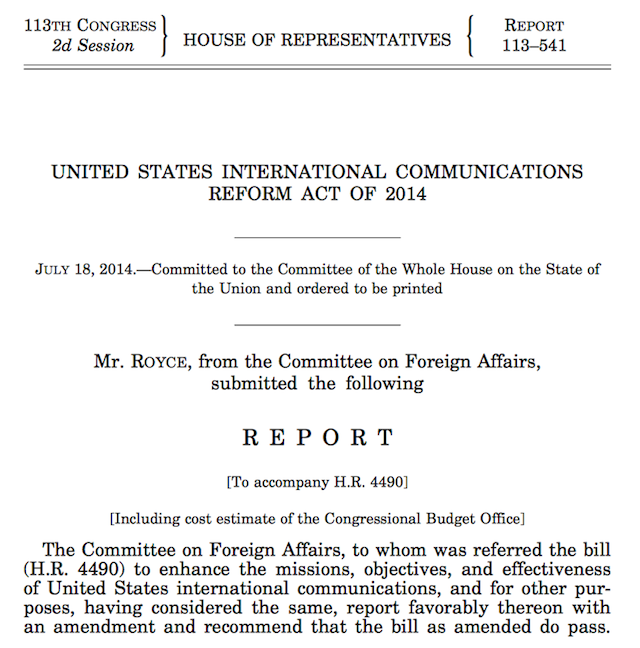
Comments are closed.